Feline Focus

Feline Focus
My latest puma, July 2016

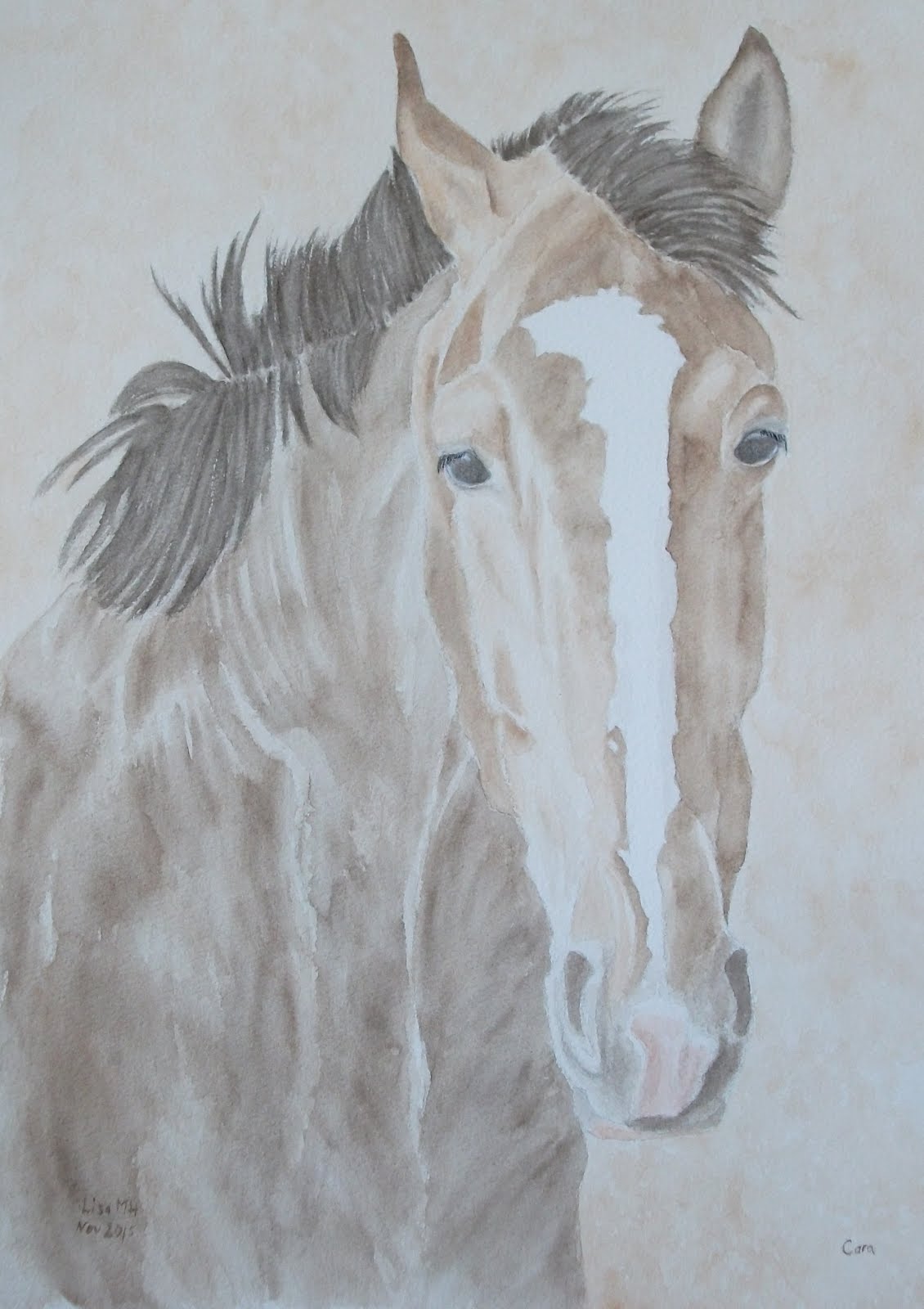
Carra

Carra
Beloved companion to Sarah, Nov 2015

Window To The Soul

Window To The Soul
Watercolour Horse, June 2015

Sleeping Beauties

Sleeping Beauties
Watercolour Lionesses, Nov 2012

QUOTES QUOTA

"Outside of a dog, a book is man's best friend. Inside of a dog it's too dark to read."

"Those are my principles, and if you don't like them... well, I have others."

Groucho Marx


Snow Stalker

Snow Stalker
Another snow leopard - my latest watercolour offering - July 2013
Showing posts with label Literary Inspiration. Show all posts

14 September 2018

LITERARY INSPIRATION #10

BOOK - DIRK GENTLY’S HOLISTIC DETECTIVE AGENCY by Douglas Adams

“It slowly surveyed the whole field, and then decided to plan out a nice, relaxed day for itself.  A little trot later on, it thought, maybe around threeish.  After that a bit of a lie down over on the east side of the field where the grass was thicker.  It looked like a suitable spot to think about supper in…
Good.
An excellent plan.
And the best thing about it was that having made it the horse could now completely and utterly ignore it.  It went instead for a leisurely stand under the only tree in the field.”

I came across this particular quote this morning as I was reading this book (well I wouldn’t have found it had I been reading some other book, so that’s a bit of a redundant statement, but anyway…), and felt it described so perfectly and succinctly the particular way my brain works when it comes to the issue of planning that I just had to share it.

I try to make plans.  Sometimes I make them complicated, with a long series of instructions to follow.  Sometimes (though, admittedly, not often) I make them simple, using a short suggestion.  Whichever way I try, the inevitable result is the same - I, for some unfathomable reason, end up completely ignoring them and doing the opposite.  The minute I form any word or thought which vaguely resembles some kind of plan, guideline, or even a nebulous desire as to what I’m going to do, or want to do, then I can basically kiss goodbye to seeing it come to fruition any time within my conscious present.

Which basically seems to mean that in order to get anything done I have to be in a state of unconscious awareness (or conscious unawareness?) of what it is I’m trying to achieve, because my brain appears to be wired to purposely contradict my instructions.  It “thinks” it knows better than me.  And perhaps it does?  Perhaps, like the horse, I should simply go with it - enjoy myself making a plan, and accepting that at the end of what is essentially a pleasant bout of idle daydreaming I’ll simply discard it and do something else.  The horse seems perfectly content with this idea, so perhaps I  would be too if I simply embraced it, rather than agonising over why this happens, and trying to force it not to do so.

Lesson for today - nature has many lessons to teach us especially about going with the flow, and even horses have wisdom to impart.

(And before anyone feels compelled to point out that horses don’t think like people, and that the horse in this book is not real but a figment of the imagination of Douglas Adams, I know.  Thanks.  I’m literal, but not quite that literal.  Well, not all the time, anyway…)

06 August 2017

LITERARY INSPIRATION #9

BOOK - MOON OVER MANIFEST by Clare Vanderpool


 ‘I thought I knew a thing or two about people.  Even had my list of universals.  But I wondered.  Maybe the world wasn’t made of universals that could be summed up in neat little packages.  Maybe there were just people.  People who were tired and hurt and lonely and kind in their own way and their own time.
Once again, I felt off balance, as if I was playing tug-of-war and the person I was tugging against let go.’


‘They talked of their common experiences of travelling to America on ships filled with immigrants, tears of emotion welling up as they recounted their first sightings of the Statue of Liberty, and the joy and fear of arriving at Ellis Island.
“I was so afraid I would be turned back,” said Mrs Cybulskis, wiping her brow with the back of her hand.  “The way they examined everyone for disease and malady.”  The women nodded in agreement.  They had all experienced the fear of being labelled unfit to enter America.  A simple chalk mark drawn by the medical examiner on one’s clothes could have a person barred from entering his newly adopted country.  An E for eye problems, an L for lameness, an H for heart problems.  They would have to board another boat and go back to wherever they’d come from no matter how long a journey they had just travelled.’

My experience with buying and reading recently published children’s books has been a bit hit and miss - I prefer older books, which I have found are generally (though not always) much better written.  But occasionally I’ve stumbled upon some good newer ones, this being one of those.  

I really loved this book, and it made me cry (though that isn’t to say that it is one of those awful, gloomy books, designed to manipulate your emotions - I read one of those a few months back, and I was so angry with it I gave it away: I couldn’t bear to have it in my home, it pissed me off so much).  It’s bitter-sweet, and so beautiful.

As you can see from the second quote above, it is also extremely relevant to what is going on in the world today, with the “immigrant crisis”.  And yet the book, published in 2010, switches between a dual timeline of 1917/18, and 1936, and is describing how immigrants were treated back when they were fleeing Europe and the devastation of the First World War.  
So nothing much has changed, then.  Immigrants are still as unwelcome as they’ve always been, it seems.  And yet the irony in this is the fact that most of us are either immigrants, or the descendants of immigrants (whether in the recent or long distant past), but so many people don’t realise, or choose to forget, that fact.  No matter how you try to look at it, “All is One” and, therefore, we are all part of the whole.

Peace to all.  Namaste.


26 April 2017

LITERARY INSPIRATION #8

BOOK - THE VELVETEEN RABBIT OR HOW TOYS BECOME REAL by Margery Williams

An explosion of rabbits!

“What is REAL?” asked the Rabbit one day, when they were lying side by side near the nursery fender, before Nana came to tidy the room.  “Does it mean having things that buzz inside you and a stick-out handle?”
“Real isn’t how you are made,” said the Skin Horse.  “It’s a thing that happens to you.  When a child loves you for a long, long time, not just to play with, but REALLY loves you, then you become Real.”
“Does it hurt?” asked the Rabbit.
“Sometimes,” said the Skin Horse, for he was always truthful.  “When you are Real you don’t mind being hurt.”
“Does it happen all at once, like being wound up,” he asked, “or bit by bit?”
“It doesn’t happen all at once,” said the Skin Horse.  “You become.  It takes a long time.  That’s why it doesn’t often happen to people who break easily, or have sharp edges, or who have to be carefully kept.  Generally, by the time you are Real, most of your hair has been loved off, and your eyes drop out and you get loose in the joints and very shabby.  But these things don’t matter at all, because once you are Real you can’t be ugly, except to people who don’t understand.”


Love this book.  It’s only forty-four pages long, but the message is beautiful, and I always cry when I read about the little rabbit becoming fully real at the end.

And, hopefully, without getting tangled up in abstract language and waffle about feelings (which I have, but have a hard time identifying or expressing “appropriately”), and being emotionally available, and authentic (come again?), here’s what being real means to me, as an autistic.

Stop denying my autism (and adhd) in an attempt to fit into the neurotypical world, which is presented as the primary blueprint for how to live a happy and successful life. 

In practical terms, this means not searching for answers on the internet, or in books and other literature written by non-autistics, for how to manage my life as an autistic. This encompasses everything, from sites dedicated to autism (telling me what’s wrong with me, how to deal with it, and manage my life as an autistic more effectively), to all those non-autistically-related sites that want to tell me how to do everything more effectively and productively, from writing and art, to how to organise everything in my life, from my shelves to my time.  

Simple but not easy, given that I have an in-built, arbitrary drive to copy; a rigid viewpoint about there being a right and wrong answer; and a fear of making mistakes.  Hence constantly checking to see whether I’m doing things right, or whether anyone else has a better answer that I just haven’t thought of because of my limited imagination.  Plus, I just seem to have a peculiar obsession with all things neurotypical, even when I don’t agree with anything they say!

Of course, this is not very useful in helping me to become more consciously aware of, and comfortable with, who I am, if I’m trying to look at myself through the eyes of someone who has no comprehension or experience of what it’s like to be autistic.

Ultimately, though, I think the message of this book is that becoming real is a gradual process which happens over time.  So, even though I do still get lost at times comparing myself to non-autistics, and temporarily forget myself (but who has someone to remind me of the truth of who I am), I have turned into a real person - one who, right now, happens to be really obsessed with the internet! 


31 March 2017

LITERARY INSPIRATION #7

BOOK - THE HOUSE IN NORHAM GARDENS by Penelope Lively


“There is a rather regrettable tendency nowadays to fence people off according to age.  The “young” - as though they were some particular breed.  A misleading idea, on the whole.  Perhaps you are just not good at being fenced off.”
“Oh.  I see.”
“The same is done to us, of course.  The old.”
“Do you feel fenced off?”
“Only by the tiresome business of one’s joints going stiff, and one’s teeth falling out, and not hearing so well.  Otherwise one is much the same person as one has always been, and the world is no less an interesting place, I promise you.”


“That must be good.  To live with old people.”
“Yes.  Yes, it is.”
“But here you do not respect old people as much as we do.  In my country we admire the old.  We take advice from them.  Here it is the young who are admired.”
“Oh,” said Clare.  “Are they?”
“Of course.  Haven’t you noticed?  They are made to feel important.  Their opinions.  What they say, what they want.  You push your old to one side.  You let them be poor.”

Despite being published in 1974, when I was seven years old, I’d never heard of this book until last year.  It is possible that I did read it back in the depths of my childhood, but that I have forgotten it - I did devour so many books, so quickly, once I discovered the joy of reading, that I cannot recollect all of them.  

Then there’s the fact that this is a very ‘quiet’, character-driven book, full of nuanced messages, and hardly any action - all of which would have gone completely over my head back then, and would not have interested me.  I was attracted to adventure books, like The Famous Five, Mallory Towers, and the Nancy Drew books; which then morphed into the thrillers of authors like Alistair Maclean, Desmond Bagley, Frederick Forsyth, and Gerald Seymour.  High on plot and action, low on all of that sappy emotional waffle, is how I viewed things back then.  

Notice how there’s a lack of female authors in that list.  By the time I reached my teens, I’d developed an abhorrence for all things feminine, which I considered to be weak, and wussy - an example of me doing what it describes in the first quote, ‘fencing people off’ (known to me as compartmentalising), only I did it based on gender rather than age. 

But, remarkably, here I am now, discovering a wonderful world of ‘quiet, character-driven’ literature (mostly written by women, mostly children’s books) filled with timeless messages - in this instance, about the young (and youth) being revered, and the old (and ageing) largely ignored and/or reviled, and both demographics being pigeonholed.

And I have to say, as I head towards my fiftieth birthday this year, that getting older is not the awful experience I imagined it to be (which was based mostly on the messages I’ve received and absorbed from the anti-ageist society I live in).  It’s true: based on my increased life experience, I actually do have more wisdom now (or perhaps that should be 'some'?!).  

I also feel more intelligent, which is probably based on the increase in knowledge I have attained; though it hasn't changed the fact that I still don't have any common sense, and that what's obvious to other people is not so to me.  As my friend Dee says, I am so intelligent that she can't believe how dumb I am sometimes! 

Plus, the most fun, least conventional, most unique, creative, energetic, enthusiastic, interesting, knowledgeable, and wisest person I know on the planet (and have ever met in my entire life) is my best friend Dee, who just happens to be coming up to her seventieth birthday, and actually gets younger in spirit every year, as she continues to be freed from the constraints that society tries to place on us.  

So, those people who revere youth can keep it.  I never had a worse time in my life than the first thirty years.  It was so miserable, I tried to put an end to it after twenty-one.  I now consider that, for some of us, youth is an affliction not a blessing.    

LITERARY INSPIRATION #6

BOOK - THE HOUSE IN NORHAM GARDENS by Penelope Lively


“So what I really wanted to say was that you must remember that language is an instrument, Clare.  An instrument to be used precisely.  Nobody can say what they mean until they use words with precision.”


“Language,” said Clare to Liz, “is an instrument.  You have to use it precisely.  Like a screwdriver or something.  Not just bash around vaguely?”
“What are you on about?”
“But the trouble is people don’t.  They say things like “quite” and “rather” and “ever so many” and “by and large” and “much of a muchness” and “quite a few”.  Now what do you suppose a person means when he says “quite a few”?”
Liz said, “It would depend what he meant quite a few of.  Bananas, or miles, or people living in Manchester.”
“Years.”
“Then it could mean anything.”
“Quite,” said Clare.

My sentiments exactly!  I couldn’t have put it better myself.  She has expressed succinctly in two passages the literary and conversational frustrations of a literal-minded and grammar-obsessed autistic.  Enough said.  I should just let the words speak for themselves.  Shut up, Lisa, and sod off. 

06 March 2017

LITERARY INSPIRATION #5

BOOK - THE HORSE AND HIS BOY by C S Lewis


“Draw near, Aravis my daughter.  See!  My paws are velveted.  You will not be torn this time.”
“This time, sir?” said Aravis.
“It was I who wounded you,” said Aslan.  “I am the only lion you met in all your journeyings.  Do you know why I tore you?”
“No, sir.”
“The scratches on your back, tear for tear, throb for throb, blood for blood, were equal to the stripes laid on the back of your stepmother’s slave because of the drugged sleep you cast upon her.  You needed to know what it felt like.”
“Yes, sir.  Please…”
“Ask on, my dear,” said Aslan.
“Will any more harm come to her by what I did?”
“Child,” said the Lion, “I am telling you your story, not hers.  No one is told any story but their own.”

This, along with The Lion, The Witch, and The Wardrobe, is my favourite Narnia book.  And for someone like me who frequently worries about the rest of the world, and gets overwhelmed by all of the stories of injustice, persecution, inequality, wrongdoing, etc when I misguidedly venture out into that world (via the glimpses I get on my computer, when I go wandering the web), I find it comforting to be reminded that I can only really know my own story, and that I’m not expected to take responsibility for anyone else’s.

I was in the middle of worrying about the state of the world (as I frequently do), and whether it’s okay to be happy when it appears that there’s so much misery out there, when this quote popped into my head.  So it was a relief to re-read it, and be reminded that God is in charge, not me, nor anyone else on this earth.  And S/He/It doesn’t expect me to ‘sort out’ the problems of the world, just work on my own little corner.

As to the first part of the quote, I guess you could interpret it as an example of karma - what goes around comes around.  Each action we take produces consequences, whether negative or positive, obvious or subtle.  It’s just a universal law of nature, and is not the evidence of a punishing God (an idea which I’ve struggled to be rid of for a long time).    

Or, to put it another way, “Do unto others as you would have them do to you.” 


07 January 2017

LITERARY INSPIRATION #4

BOOK - DADDY-LONG-LEGS by Jean Webster

“It isn’t the great big pleasures that count the most; it’s making a great deal out of the little ones - I’ve discovered the true secret of happiness, Daddy, and that is to live in the now.  Not to be forever regretting the past, or anticipating the future; but to get the most that you can out of this very instant…  
Most people don’t live; they just race.  They are trying to reach some goal far away on the horizon, and in the heat of the going they get so breathless and panting that they lose all sight of the beautiful, tranquil country they are passing through; and then the first thing they know, they are old and worn out, and it doesn’t make any difference whether they’ve reached the goal or not.  I’ve decided to sit down by the way and pile up a lot of little happinesses, even if I never become a Great Author.”


Yet another remarkably prescient quote, from a book published in 1912.  Imagine that - people back then, in what we would consider to be the dark, distant past, having the same thoughts, feelings, struggles, and experiences that we do today.  

I always find it amazing when I discover things like this that connect me to our ancestors (even if it’s only temporary and fleeting, which it always is for me), that prove that nothing that is happening today is new, and that show that the same solutions to the problems of living are as relevant today as they were a hundred years ago.  And that they are, in essence, simple (not necessarily easy, but still simple).  

“Mindfulness”, and “living in the moment” are not new concepts (one of the principles our AA programme is centred around is the idea that we can only live one day at a time, and that was formulated in the 1930s).  It’s just that people now have found a way to complicate even more what is a simple thing in order to be able to write whole books about it, and produce other marketable merchandise, in order to make a profit from it.  Which I find sad.  And, after all, who would buy a book about living in the now if it only contained one quote on one page?  

There are so many nuggets of truth to be found in novels, and children’s books in particular, that don’t come with complicated instructions, or plots (which I cannot follow for the life of me - and Lord have I tried).  Which is why I love children’s literature - especially the older stuff that wasn’t influenced so much by what now seem to be the predominant driving forces of marketing and profit.


Times past may not have been any simpler than they are now, but there is much to be said for returning to a simple code of living - which starts with living in the day and the moment.  It’s something I suddenly realised I had forgotten about, except as an abstract concept which I knew I should really be trying to practise, but which, because of its intrinsic difficulty, I struggle to persist with.  

But, after all, this is where the Essence of all life resides, where the connection made with my Higher Power (which I call God) takes place, and where I receive all the power I need to deal with what is in front of me to do today - not in the future, or the past, which are places which now exist solely in my mind, and are therefore no longer ‘real’ (in the sense that they are not part of my reality today, not in the exact form which they manifested back then).

And it is true that I only ever feel peace when I’m in the present - which explains why it is such a rare and fleeting thing, since I am so rarely here in the moment.  All the more reason to practice it, methinks.

31 August 2016

LITERARY INSPIRATION #3

BOOK - THE SILVER CHAIR by C S Lewis


“But first, remember, remember, remember the signs.  Say them to yourself when you wake in the morning and when you lie down at night, and when you wake in the middle of the night.  And whatever strange things may happen to you, let nothing turn your mind from following the signs.  And secondly, I give you a warning.  Here on the mountain I have spoken to you clearly: I will not often do so down in Narnia.  Here on the mountain, the air is clear and your mind is clear; as you drop down into Narnia, the air will thicken.  Take great care that it does not confuse your mind.  And the signs which you have learned here will not look at all as you expect them to look, when you meet them there.  That is why it is so important to know them by heart and pay no attention to appearances.  Remember the signs and believe the signs.  Nothing else matters.”  

I love the writing of C S Lewis, and especially the Chronicles of Narnia, of which The Silver Chair is book six.  This is kind of ironic, given that he was a devout Christian and apologist of his faith, and I am definitely not religious; but I believe in a Higher Power, a universal Creator, an Energy underlying everything (both seen and unseen), which I no longer have a problem calling God, and which is where I find myself in agreement with Lewis.  

This somehow allows me to be able to go beyond the Christian allegory within his stories, and interpret them in a way that makes sense to me, fitting in with what I believe.  This, I think, is what makes him such a good story writer.  The Narnia books can be read as straight-up fantasy-adventure (which is how I viewed them for years), or as deeper, allegorical tales: they work both ways.   

Unlike his Christian non-fiction, in which he is extremely adamant and forceful with his opinions, which doesn’t allow much (if any) room for manoeuvre or personal interpretation (I recall a quote in which he is absolutely insistent that Jesus was not a mere man and great moral teacher, but the Son of God), there is room for such here in his stories. 

My beautiful hardback copies, which I've had for eighteen years.
As to the way I view this passage, to me it perfectly symbolises the process of meditation.  The clear, still, peaceful air of the mountain-top represents the elevated state, beyond the clamour of the mind and the material world, needed to be reached  in order to be able to ‘hear’ what God is trying to communicate (and I see Aslan as representing God, not Jesus); a place where I am one with the Universe.  

Interestingly, in yoga (and other forms of meditation) this is achieved by slowing down the breath, and breathing deeper, thus allowing more, fresh air (and the energy of the universe - the breath of God, the breath of Life, if you will) into the mind and body, to clean and clear the system, paradoxically both filling and emptying it at the same time (but then I guess God is the ultimate paradox, being both Everything and Nothing, the Beginning and the End, and everything in between - simultaneously.  Gosh, I feel a profound moment passing over me…)

The thickening of the air to which Aslan refers conjures to my mind all of the build-up of energy and noise, distractions and demands, that come with living in such a heavily populated world.  It’s often very difficult to see God in the midst of all that hubbub*, to be able to decipher what S/He is trying to ‘say’ to me because of all of the complications that we, as people, bring to life: interpreting God’s signs in the context of our confused reality takes a lot of practice, and is always best undertaken with the help of someone on the same path, some kind of spiritual mentor (fortunately for me, my AA sponsor fulfils this role).

But the great thing is that I can always return ‘to the mountain top with Aslan’, anytime, if I just remember.  And it’s not complicated (not easy, but simple) - I just have to sit still somewhere, and breath deeply.  For as long as necessary.  And to remember that, ultimately, nothing else is as important as connecting with the flow of Energy, and following God, because S/He/It is all Life, Creativity, Happiness, Joy, and Freedom - no matter that the world tries to convince me otherwise.  I just have to breathe It in, embrace It, and act on It.  As the book quote says: “NOTHING ELSE MATTERS.”

So, I leave you to your own interpretation.  Hopefully it might have inspired some of you to check out the book (or books) if you’ve never read it/them: or, if you have, to return to them with new eyes, if you’ve never seen beyond the surface.

I wish for you your own mountain-top retreat - a place to reconnect with your Source, and replenish your soul.

Namaste  


*I double-checked the meaning of this, and found the perfect definition in my dictionary: “confused sound of many voices”.  Sounds about right.

The quote, in situ (in my large, omnibus edition, which is also about eighteen years old)

07 August 2016

LITERARY INSPIRATION #2

BOOK - THE SECRET GARDEN by Frances Hodgson Burnett

“One of the new things people began to find out in the last century was that thoughts - just mere thoughts - are as powerful as electric batteries - as good for one as sunlight is, or as bad for one as poison.”

My very old, well-loved, and frequently-read copy of The Secret Garden

This is another children’s book which I missed out on reading in my childhood, but was fortunately introduced to in my thirties (by the same person who led me to Pooh, and many other classic children’s books, re-igniting a love of children’s literature which I believed I had outgrown); and which transcends the children’s/adult literature divide.  I love this book, and felt a deep connection with Mary Lennox, and her contrary personality - despite the fact that she is not autistic.

One of the things I find most remarkable about this quote is the fact that it comes from a book that was published in 1911.  Yes, that’s the beginning of the last century (the twentieth) - which means that the century to which she is referring in the quote is the nineteenth.  People had figured out back then in the eighteen hundreds that our thinking has a powerful impact on our health.

I think I was gob-smacked when I first read it; to think that there were those in the Victorian age who were becoming enlightened about things that people now talk about as if they’ve only just been discovered - ‘reinventing the wheel’ is, I believe, the applicable phrase.

And, despite the fact that the evidence for these things being true has been around for over a  century, there are still those today who don’t believe it.

I don’t know why this should be a surprise to me, because I am purportedly a yogi, and yogis have been propounding the same beliefs for a lot longer (we’re talking over two THOUSAND years, not just over a hundred); but maybe it’s to do with the fact that India and the East has a long-standing association with the spiritual and metaphysical, whereas I think of the West as deeply entrenched in religion (which is different in my mind to spirituality), and the material/physical world.  

We had not long since gone through the Industrial Revolution, which gave no consideration to a person’s mental, emotional, or physical wellbeing, only to how much work could be forced out of them.  People, it seems, essentially became an extension of the machinery they operated.   

All of which just goes to prove what slow progress we human beings make, despite our much-vaunted intellectual evolution; and that there really isn’t anything new - people are essentially the same now as we were back then: we’re just recycling the same ideas, but from a different perspective.  Plus, we simply obfuscate the truth with different language.  Jargon, anyone?

And as to whether the theory is true or not, I have only to investigate my own life, and how depleting is the impact of harbouring negative thoughts.  As the saying goes, “Like attracts like”. 

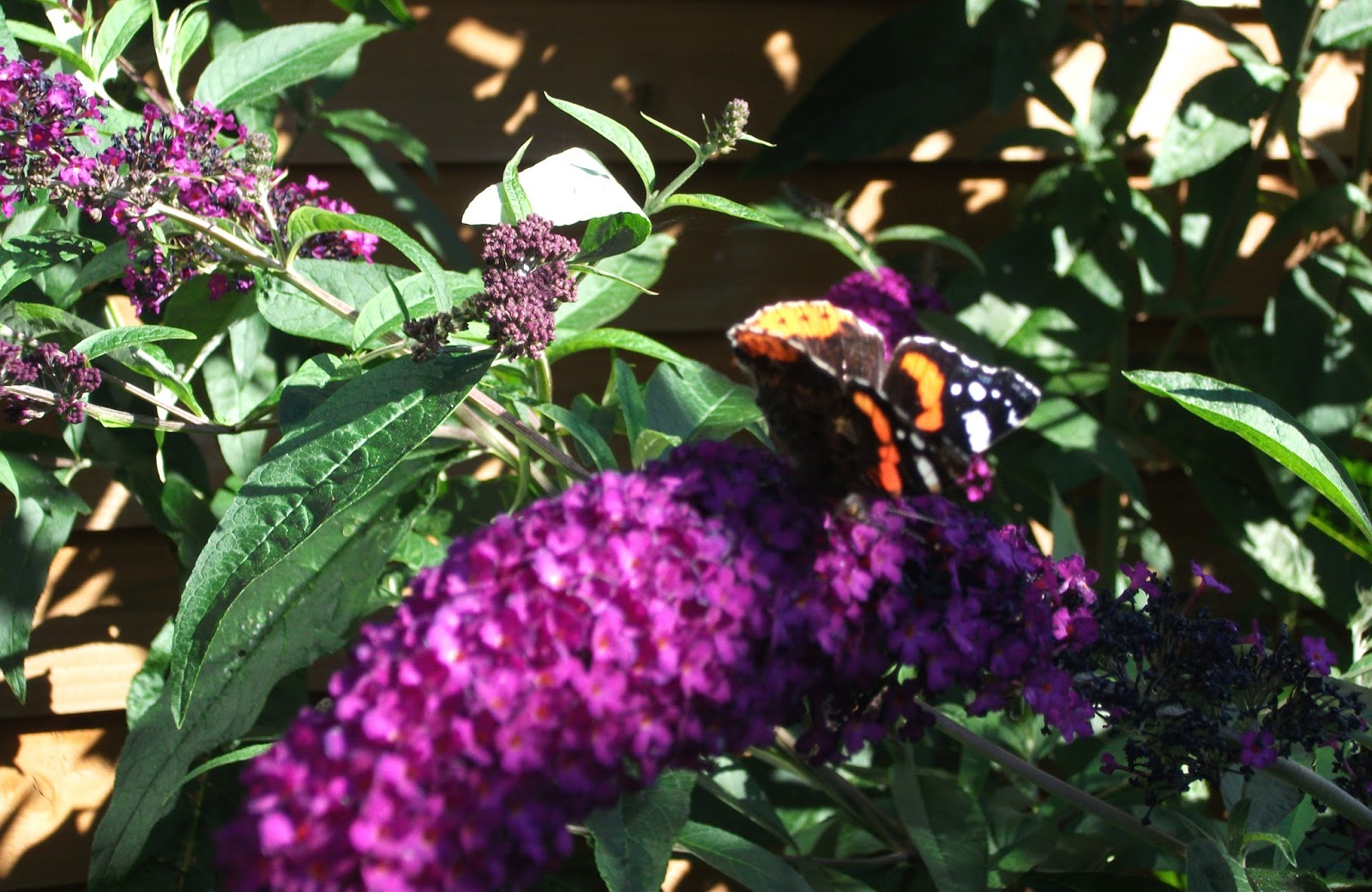
Peacock butterflies in my own sort-of-secret garden
A Red Admiral butterfly
My own small, semi-secluded garden

30 July 2016

LITERARY INSPIRATION #1

BOOK - THE HOUSE AT POOH CORNER by AA Milne 

“Supposing a tree fell down, Pooh, when we were underneath it?”
“Supposing it didn’t,” said Pooh after careful thought.


A beautifully succinct, and funny, example of the difference between a glass half-empty, and a glass half-full personality.  

This exchange takes place between Piglet (the quintessentially anxious character), and Pooh, whose positivity knows no bounds, and who blithely glides through life, distracted by his love of honey, and bits of poetry that come and find him.  

I am, of course, a Piglet (in the case of this particular character trait); except when I’m being a Pooh, about food especially.

The chapter from which the quote is taken
One of my favourite books (or series of two, to be precise), which I bewilderingly never read as a child, but fortunately was introduced to when I was thirty - an age more suited to the appreciation of the finely-nuanced characters, and the subtle humour.  Not something you could say about the Disney version. 


26 July 2016

LITERARY INSPIRATION - AN INTRODUCTION

A small selection of my books, presided over by a small Pooh

I love quotes - which you may have noticed if you’ve looked around my blog.  Unfortunately, there isn’t enough room to fit in as many as I would like, otherwise there would hardly be space for anything else.  (I am thinking of adding another Page to the sidebar, for other random quotes I’ve collected.  Probably to be called “Quote Unquote”.)

I also love books.  And, since a lot of great quotes come from literature, I’ve decided to combine the two, and start what will hopefully be a regular series of posts where I share favourite quotes or passages from my books, with a few of my own thoughts about it, and a photo or two of said book attached (as it’s given me a reason to use the camera I’ve had, and hardly used, for nearly three years).

Just to reassure you, despite the possible implications of the title, this is not going to be filled with words from great, deep (the kind you need a JCB for to dig up the meaning), heavy, worthy, ’classic’ works of literature; nor, even, any such recent books.  

That is not the kind of stuff that I like: it bores the arse off of me, and I am hopeless at finding the deeper, symbolic meaning in those stories, despite the fact that I love the English language, and seem to have been born with a natural affinity for it.  Well, for using it: trying to understand everyone else’s use of it tends to leave me flummoxed.

I did take 'A' Level English Literature at college, where we studied and analysed great works of literature.  Well, at least, everyone else did: I simply floundered, and failed miserably at it.  I think it might have derailed my love of reading for a long time after that.  Mind you, for some perverse reason when I left college I started reading more classic books - like the whole of the Brontë canon, and Thomas Hardy, along with things we hadn’t studied, like Jane Austen.  I don’t know what’s going on in my brain half the time.  

A large Pooh with a different view

Ironically, despite it being thirty years ago since I left college, I do remember all of the books we studied; they were indelibly imprinted into my brain through repeated analysis.  Therefore, I thought I’d take a trip down memory lane, and share the joy with you.  So here they are:

The Canterbury Tales by Geoffrey Chaucer 
Thankfully we only studied one of them (can’t remember the name now, but it was one of the lesser-known ones).  It was in the original “olde" English, which we had to translate into modern English, before having to interpret the bloody thing!  The only thing I can remember is that there was an old, blind man with a very young wife, and she was having an affair with some young bloke.  The husband found this out in an embarrassingly explicit scene when, having had his sight come back, he went to tell her, only to find them having sex in a tree.  Bizarre.  And tedious.  And completely mind-boggling to me: why, and how, would anyone have sex in a tree?  

Othello by William Shakespeare 
Early example of interracial marriage, and the power of jealousy to destroy.  And a symbolic description of a slimy toad.  Again with the having to translate it first, though not so dense as Chaucer.  Nothing could be so dense as Chaucer.  Not too bad after having the imagery and language explained (so that basically covers the whole thing then), though I wouldn’t understand it by myself.  But I remember the main characters - Desdemona, Iago, Cassio, and, of course, the eponymous Othello.  And there’s dying.

Richard the Second by William Shakespeare 
The less famous of the two Richards (the other one being the Third, and having a hump).  Sad bloke, bit whiney, completely lacking in any self-awareness, especially of how he got himself in this mess.  Vaguely recall the famous speech about “this sceptred Isle, this England…”, and characters called Bolingbroke, and John of Gaunt.  And Richard dies in the end.  Of course.  

Wuthering Heights by Emily Brontë  
Oh my God, one of the most torturous, tortuous, and utterly tedious books I’ve ever read.  I just wanted to slap Cathy, and drop Heathcliff off a cliff.  I’m happy to say I think they both died in the end.  

The Go-Between by L. P. Hartley  
I think we must have really hammered at this one because not only do I remember the plot (boy goes to stay with his friend, falls in love with friend’s much older sister; sister is having affair with local farmer, which is forbidden ‘cos he’s lower class; sister and farmer use boy to deliver messages between them; sister and farmer get caught in flagrante delicto; all goes pear-shaped, blah blah blah.  All very heart-wrenching and tedious), but I also remember the first line: “The past is a foreign country; they do things differently there.”  Plus a scene with a red bicycle, which is meant as a phallic symbol, ‘cos it’s just before the sister and the farmer get caught having sex.  Went right over my head.  No death, just heart-wrenching separation and longing.  I longed to be separated from the book.

Volpone by Ben Jonson  
About a man (a costermonger, I think) whose name (the title of the book) reflects his character - literal translation ‘the Fox’: wily, sneaky, sly, and untrustworthy.  I think he tries to seduce the daughter of some wealthy merchant, but I’m not certain.  By the time we got to this book in the course, I think I’d lost the will to live.  And the ability to retain any more information.

The Return of The Native by Thomas Hardy  
I mistakenly thought this was going to be about a black person in Africa (I had a one-dimensional interpretation of the word ‘native’ at that time).  So you can imagine my surprise when it turned out to be about some white woman returning to her home somewhere in England (or was it Wales?  It eludes me, the tale was so riveting.  Perhaps I’m getting confused because I think there was a t.v. version made with Catherine Zeta Jones, who is Welsh).  And that’s about as much as I can remember, other than that, as with all Hardy books, it was terribly fraught, dark, and depressing, and someone probably died at the end.  Oh, and lots and lots of symbolism, to do with the scenery.  Which was dark, dank, and donk.*

A few more books

And there you have a brief history of my literary history.  Thankfully I eventually moved on from all of that, and I found stuff that I really liked (as opposed to more of the stuff I thought I should like, due to my literary aspirations, and my unfortunate autistic propensity for absorbing and copying whatever I come into contact with).  This means Terry Pratchett, and a whole lot of children’s books - especially Winnie the Pooh (the REAL one, NOT the Disney one), The Secret Garden, and The Chronicles of Narnia.  Expect lots of quotes to be culled from these.

In keeping with my newly discovered enthusiasm for blogging, based on the principle of NOT following a plan, I will not be making proclamations about how often, and on what day, I shall be posting these snippets.  That way lies madness - and the inevitability that I shall end up doing the opposite, which could mean not at all, ’cos that’s in my nature.  

I am hoping to post them regularly, but that could mean anything from once a week to once a month, or even (God forbid) once a year, and anything in-between: so expect them when they arrive.  I’m also hoping that, in the new spirit of continuity I am attempting to achieve, they will serve as inspiration for me to stay connected to my blog, giving me something to write if I run out of ideas for a random post.  I guess we’ll see.  I’m trying to go with the flow, and let things evolve organically, rather than attempting to force them to follow a path I’ve dictated is the right one (which is based on what I’ve read about how everyone else does it).

So there we go.  I’ll shut up now.  This was meant to be a short introduction, but see what I mean?  I say I’m going to do one thing, and the opposite occurs.  I will shut up now.  Bye bye.  Happy reading. 

* This is a line from one of The Goon Show episodes.  I can’t remember which one. 

Snow Leopard

Snow Leopard
An experiment in watercolour and gouache

Quotes Quota

"Do you believe in Magic?" asked Colin.

"That I do, lad," she answered. "I never knowed it by that name, but what does th' name matter? I warrant they call it a different name i' France an' a different one i' Germany. Th' same thing as set th' seeds swellin' an' th' sun shinin' made thee well lad an' it's th' Good Thing. It isn't like us poor fools as think it matters if us is called out of our names. Th' Big Good Thing doesn't stop to worrit, bless thee. It goes on makin' worlds by th' million - worlds like us. Never thee stop believin' in th' Big Good Thing an' knowin' th' world's full of it - an call it what tha' likes. Eh! lad, lad - what's names to th' Joy Maker."

From 'The Secret Garden', by Frances Hodgson Burnett

Love

Love
Copied from photograph of the same name by Roberto Dutesco

Quotes Quota

"There is no way to happiness - happiness is the way."
The Dalai Lama

"If you don't stand for something you will fall for anything."

Malcolm X

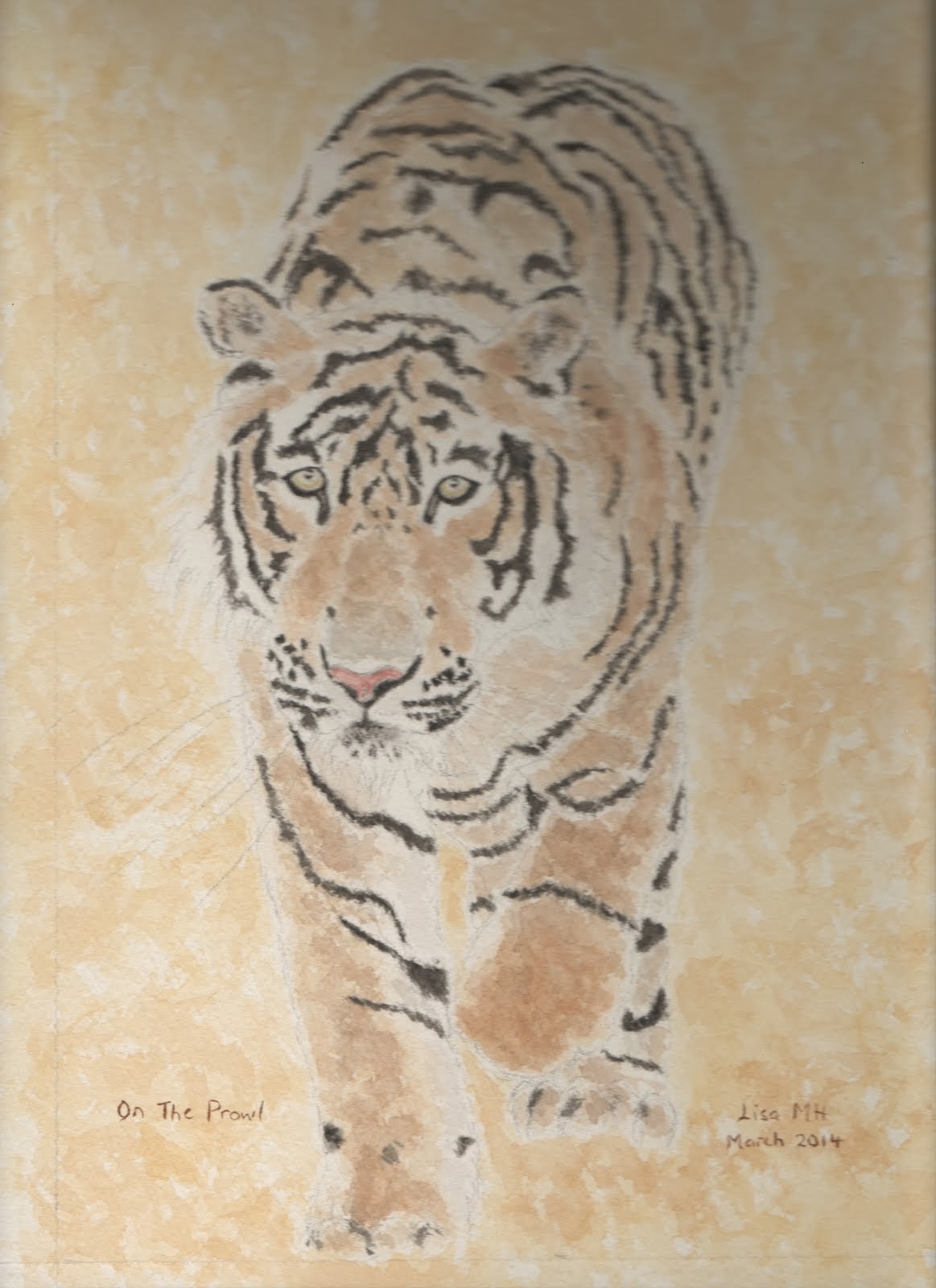
On The Prowl

On The Prowl
Watercolour tiger

Quotes Quota

"What saves a man is to take a step. Then another step."

"There are far, far better things ahead than any we leave behind."

C S Lewis