Feline Focus

Feline Focus
My latest puma, July 2016

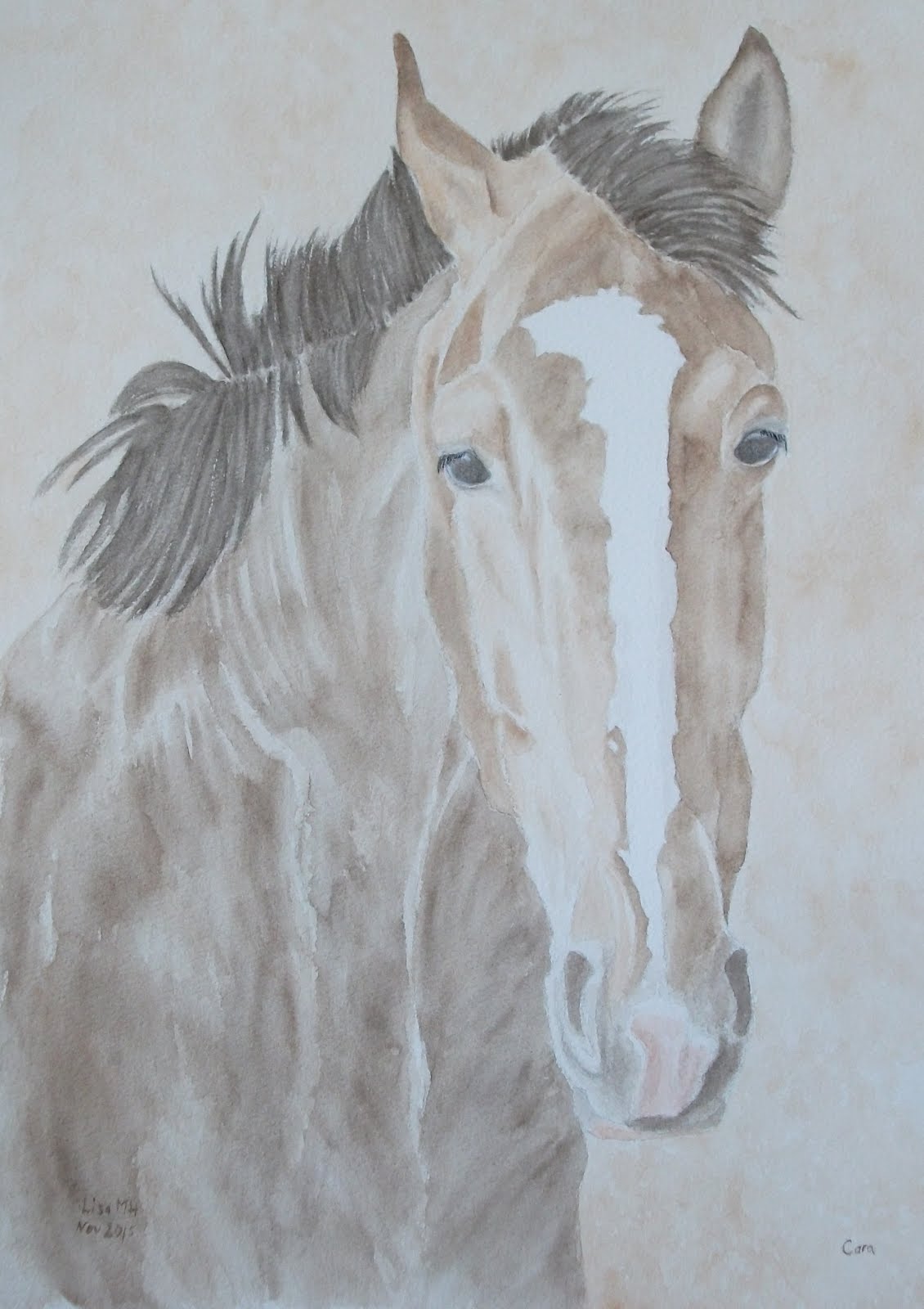
Carra

Carra
Beloved companion to Sarah, Nov 2015

Window To The Soul

Window To The Soul
Watercolour Horse, June 2015

Sleeping Beauties

Sleeping Beauties
Watercolour Lionesses, Nov 2012

QUOTES QUOTA

"Outside of a dog, a book is man's best friend. Inside of a dog it's too dark to read."

"Those are my principles, and if you don't like them... well, I have others."

Groucho Marx


Snow Stalker

Snow Stalker
Another snow leopard - my latest watercolour offering - July 2013

01 February 2016

Higher Learning

“Knowledge without wisdom is like man without a faith - a self-propelled disaster waiting to happen.”     Lisa M H 

Yes, that’s me - the self-propelled disaster area, not waiting to happen, but in a constant state of happening.

Which idiot is it who said that “knowledge is power”?  Had they never heard that “ignorance is bliss”?  Do they not know that the ‘wrong’ knowledge in the ‘wrong’ hands (or minds, to be literally precise) can be a total liability, causing great harm?  And not just to other people - there’s the stress you can inflict upon yourself just from having an insatiable need to know, without being discriminating about what knowledge you seek, and why you pursue it.

Perhaps the originator of the phrase “curiosity killed the cat” knew this, and was being intentionally vague because he thought it might scare the arse off of people if he actually reported that “curiosity killed my Uncle Horace, who read one too many medical articles about how stress could contribute to a heart condition, and promptly died from a heart attack brought on by the stress he experienced as a result of continually reading such depressing news.”  Plus, it’s not quite as catchy as the cat version.

Which brings me, inevitably, back to me - the self-exploding, knowledge-seeking missile; who, had I been a cat, would have lost all nine lives within minutes of learning how to walk.

I like to think of myself as a seeker of knowledge and truth: which makes it sound terribly noble and worthy, as if I’m on some kind of crusade, searching for a latter-day version of the Holy Grail - information.  I should be wearing armour, a cape, and bearing arms.  I think a horse might be a bit too much, though: I hardly have enough room for a cat. 

The problem is that I’m not very discerning about the knowledge I seek, or what its impact on me might be.  I am a human hoover - I mainly suck up crap.  And why should I be surprised by this when I am a hoarder by nature?  

Random ideas pop into my head, about which I am absolutely convinced I need to know more (preferably right now, or I will expire on the spot): and off I go, back onto the internet - the Font of all Knowledge (dubious as it frequently is).  My true quest, it seems, is to find a legitimate reason for being on the web.  Again. *Sigh*  God, at this rate I’ll soon be overtaking the amount of time the Crusaders spent battling in the Holy Land.  Can’t I find another quest?

So, my latest ‘quest’ (which basically means I got distracted by a thought, and have since been in obsessive pursuit) has been for self-education.  Again.  I say “again” because I have a series of interchangeable ‘interests’ , with which I become engrossed (to put it mildly - I think the more appropriate terminology is obsessed, or hyper-focused), and repeatedly return to, ad infinitum.  My forays into the realm of academia have become a regular highlight, especially since I discovered the world of free, on-line learning resources.  

“Oh joy!  Finally, a valid reason for going on the internet.”  Er, not.  “But why?  WHY?!!!!!  Why can’t I, when everybody else can?!  It’s not fair!!!!  I LOOOOOOOOOVE learning!  And EVERYBODY says learning is a good thing - a means to self-improvement.  It makes you a more interesting, well-rounded person.  And it’s good for your brain - stops it from atrophying, and improves your memory.  I’ll miss out on all of those benefits.  It has to be good for me!”

This is what the knowledge I’ve acquired from other people tells me: people I know nothing about, other than what they choose to share on their sites - and even then I cannot get a read on them, or determine whether I’m meant to take what they say literally, due to the minor issue of my being autistic (impaired social understanding, anyone?).  Which brings us to the fact that most of these people writing this stuff aren’t autistic, so they’re not writing it for me: I just think they are.

But the wisdom of my repeated experience (repeated ad nauseam because I repeatedly ignore it) tells me that I don’t do well with academic learning; that I’ve already found my calling, which is for writing and art, for which I already have everything I need within me - I don’t need to keep looking for “what I want to be when I grow up” (I’m nearly fifty, for God’s sake: I could drop down dead tomorrow, and then it’d be a bit late for that!), or just looking for more. 

And then there’s the fact that it’s passive - I don’t actually do anything, neither whilst learning, nor with the knowledge I acquire, other than let it wash over me, and hopefully retain some of it (or not, since most of it goes over the top of my head anyway, for one reason or another - distraction and boredom being the two main culprits).  It just becomes another obsession with which to bore myself, and any other poor sod who’s unlucky enough to gravitate within my orbit at the time, until it fizzles out and I move on to the next thing that grabs my attention.  “Oh joy.”  *Sigh* 

But the real irony is that, despite apparently being extremely intelligent, I struggled with learning at school (other than English, for which I have a natural affinity), mostly due to a mixture of anxiety, easy distractibility and loss of interest, and just plain confusion about the subjects I was learning: they didn’t fit within the context of my life, other than as an abstract means to an end - that of passing exams in order to secure either a ticket into higher education, or a good job.  

And I don’t do abstract.  Nor do I do the formal model of education, or learning, but still I ignore my inner wisdom and keep on trying to fit myself into a round hole when I’m most definitely an alternatively-shaped peg.

So I guess it’s not what you know, but what you do with what you know.  Or what you don’t do with what you know.  Or even what you do with what you don’t know.  Or what you do when you don’t know.  The possibilities, it seems, are endless… like this paragraph.

And I guess that’s why we refer to the wisdom of Solomon, not the knowledge.

Knowledge you learn, wisdom you earn.

15 July 2015

If You're Happy And You Know It, Flap Your Hands

“When I became a man I put away childish things, including the fear of childishness, and the desire to be very grown up.”    C S Lewis

Are you a flapper, a rocker, a spinner, or maybe even a twitcher?  In other words, do you stim?  For the uninitiated it means self-stimulation (think hand-flapping, body rocking, spinning around in circles, etc - not masturbation!)  

I stim, though, up until recently, I didn’t really understand why.  I kind of thought it was just one of those peculiarities attributable to people with autism: yet another example of the difference between us and the non-autistic population.

Strangely enough, given its conspicuity, it’s one thing about myself of which I’ve never felt self-conscious.  Of course, this could be due to the fact that I’ve been largely unaware that I’m doing it (difficult to feel self-conscious when you’re not even conscious); or that it’s considered an odd thing to do.  Why would I?  It’s part of who I am, what I do, so to me it’s perfectly normal.  Plus, having perfected the art of avoiding looking at people (because I cannot read their facial expressions, nor simultaneously listen to, and look at, them), I have no idea whether they are looking at me, or exchanging questioning glances.  

So it wasn’t until after I’d got my Asperger’s diagnosis, years later, that I discovered that people do, indeed, notice what to them is considered to be my odd behaviour.  My best friend told me how some of the members at our local Alcoholics Anonymous meetings would stare and point at me in concern, directing their silent questioning at her to find out what was the matter with me, whilst I remained blithely unaware.  

After all, it was perfectly logical to me to bend my body into a pretzel-shape to make myself as small as possible in order to hide (I also happen to have a problem with sitting ‘properly’, and stationary, on a seat); avoid all eye contact by staring at the floor; and then soothe myself by rocking.  I was astounded to learn that it produced the opposite effect - that I made myself conspicuous, which to some people would even appear as if I was attention-seeking.  Dread the thought.

My particular preferences are for rocking, hand-wringing, stroking (myself, particularly upper arms; and, if available, dogs, cats, soft toy animals, and anything else with a soothing texture), and patting/drumming/tapping (especially my upper chest, which produces a pleasant sensation, and a satisfying noise).  I do these for their soothing and calming abilities, which makes perfect sense - think of how people rock, pat, and stroke babies.  And yet some of those same people think we’re odd.  Have they forgotten how soothing, and effective, such things were?  Perhaps it’s  because they expect us to have grown out of the need for such things: but then they don’t have a highly sensitive nervous system like ours. 

I’m also a bit of a flapper, sometimes, though I don’t do it as frequently.  This I do when I get excited about something - it’s like there’s a surge of energy that needs releasing, so madly flapping my hands helps.  It makes me look like a sea mammal flapping its flippers, so we now refer to it as me doing my seal impersonation.  

Oddly enough, until I found out I’m autistic, and then read about flapping, I don’t recall ever doing it before: unlike the others, which I know I’ve done throughout my life.  It’s like I unconsciously started copying what I’d read.  I did it with stammering, too: never stammered in my life until after my diagnosis (I’ve always been more prone to becoming mute than babbling, when anxious), then suddenly I couldn’t stop tripping over my words!  

Having discovered that what I do has a name, I have become increasingly more aware of when, and why, I am doing it, which has given me the ability to choose whether I continue to do it or not in that moment (for instance, my best friend will sometimes tell me I’m rocking whilst we’re on Skype, which can make her feel a bit dizzy, and be rather distracting for her).  What I have not consciously tried to do, though, is attempt to control it.   And yet it has lessened, seemingly of its own accord.  

I put this down to a number of factors.  One is that, remarkably for me, I have accepted it as being part of my autism, and so haven’t tried to force myself to stop doing it (an approach which has never worked yet).  Another is that the level of general anxiety I experience on a daily basis has reduced phenomenally over the last few years, which means an automatic lessening in the need to sooth and comfort myself via stimming.  You can tell when I’m really anxious because I turn into a restless, rocking rambler again.  

I believe that my improvement is due in part to the practice of the AA programme, which has led to an increasing faith and dependence upon a God of my understanding (spiritual, not religious), one of the results of which is a reduction in my anxiety about the world around me.  Then there’s the practice of yoga, which has taught me how to calm myself, and control my anxiety, through the breath. 

So, this may well sound like it’s a post about how to reduce stimming, which would totally conflict with the title, not to mention a large proportion of the content.  On the contrary, it is, in effect, a celebration of what is, essentially, an intuitive, benign tool for self-care; and the fact that I have recently discovered a socially acceptable way of stimming.  I kid you not.  

Yoga.  Seriously.  

I can’t believe it’s taken me this long to realise it (I have, after all, only been doing it for twelve years), but it makes perfect sense.  When we stim we are unconsciously stimulating the autonomic nervous system (responsible for, amongst other things, heart rate, breathing, and the fight or flight response).  The practice of yoga does exactly the same thing.  However, it wasn’t until I started supplementing my regular practice with Kundalini yoga a year or so ago that I made the connection.

Kundalini yoga employs a lot of quite vigorous exercises, which are called kriyas - a number of which actually look as if they were designed by autistics!  Truly.  So, not only am I absolutely, positively induced to try to bend myself into a pretzel shape with my usual yoga routine (something I was naturally drawn to doing before I ever came across the formal practice of yoga), but I now also get to spin in a circle, rock backwards, forwards, AND sideways, and flap to my heart’s content (with variations).

So I say flap like a loon if you feel the need; and if anyone questions what you’re doing, just tell them you’re practising yoga!


13 April 2015

I Don't Speak Text

Do you ever wonder whether we, the human race, are still progressing, or that we have come as far as we can, and are now in a state of retrogression?

The question occurred to me the other day, whilst I was compiling a list of words for inclusion in a poem (hopefully, having found myself in a rather rare poetic mood) - wonderful, juicy, full-bodied words to get one’s teeth into, chew over, digest, and enjoy, like a good, solid, satisfying meal; words to contemplate and admire for their simple ability to encapsulate within their singularity whole concepts, and to fully communicate their meaning; words which give a solid foundation on which can be constructed a sentence, a phrase, a line of poetry, an essay, a story…

And whilst rhapsodising thus over the beauty of language, my mind wandered forth onto the subject of text-speak, with its use of acronyms and contractions: a form of language no longer confined within the sphere of mobile phones and computers, but now proliferating like a fungus everywhere words are used - including in books, and other forms of literature. 

From there I was reminded of a poem I wrote, called A Yorkshire Sonnet (it’s on the Poetic License page, in the side-bar), in which I employed a broad Yorkshire dialect.  I have to confess that, whilst I am a Yorkshire lass, born and bred, I’ve always had a love of the English language, which has been developed and expanded through my extensive reading; as a result of which I seem to have been safeguarded from developing a broad Yorkshire accent or speech pattern, despite having been surrounded throughout my life by people who actually say things like, “Does tha know?”; “I were in shop other day…”;  “Gee oar (the ‘g’ is soft, as in ‘go’, and the phrase means “give over” - obviously); or my favourite, “Nayou” (that’s ‘no’ to the uninitiated).  Despite this lack of development of broad Yorkshire, I can employ it when necessary.  Which, funnily enough, is not right often. 

It struck me that there appears to be a similarity to text-speak: two examples of  seemingly underdeveloped versions of the English language (similar to olde English), with their predilection for shortening words, as if the speaker doesn’t have either the time or the inclination to give voice to fully-formed words and sentences - kind of like one step up from our linguistically-challenged prehistoric ancestors.

And then it occurred to me that the advent of text-speak, despite its connection to the world of technology, and therefore supposedly a sign of our intellectual advancement, could be seen as not so much an example of our evolution, but of a devolution: an indication that we’re in retreat when it comes to communication.  People, it seems, aren’t interested in fully or deeply communicating with each other; or they don’t have the time for anything other than shallow, alphabetised conversations, and jargon-laden interactions. 

Perhaps it’s a sign of things to come?  One day, in the not-too-distant future, we’ll all be speaking in acronyms; from whence it’s only one small step back to where we all began - mute, apart from animal-like grunts, and hand signals.  

Well I guess it’s one, albeit rather extreme, way of removing the distraction of words from my life.  Maybe then I'll get something written.


PS It wasn't until after I'd posted this piece that I was struck by the irony of a woman who struggles to communicate at any depth (surface included), despite her extensive vocabulary and proficiency with the English language, writing about the apparent lack of communication between non-autistics.  What do I know about why they choose to interact with each other in shorthand?  I barely understand them when they do speak in complete sentences.  Perhaps I'd actually do better if we did go back to the days before words.  And think of all the stimming we could do without anyone thinking we were odd.

Snow Leopard

Snow Leopard
An experiment in watercolour and gouache

Quotes Quota

"Do you believe in Magic?" asked Colin.

"That I do, lad," she answered. "I never knowed it by that name, but what does th' name matter? I warrant they call it a different name i' France an' a different one i' Germany. Th' same thing as set th' seeds swellin' an' th' sun shinin' made thee well lad an' it's th' Good Thing. It isn't like us poor fools as think it matters if us is called out of our names. Th' Big Good Thing doesn't stop to worrit, bless thee. It goes on makin' worlds by th' million - worlds like us. Never thee stop believin' in th' Big Good Thing an' knowin' th' world's full of it - an call it what tha' likes. Eh! lad, lad - what's names to th' Joy Maker."

From 'The Secret Garden', by Frances Hodgson Burnett

Love

Love
Copied from photograph of the same name by Roberto Dutesco

Quotes Quota

"There is no way to happiness - happiness is the way."
The Dalai Lama

"If you don't stand for something you will fall for anything."

Malcolm X

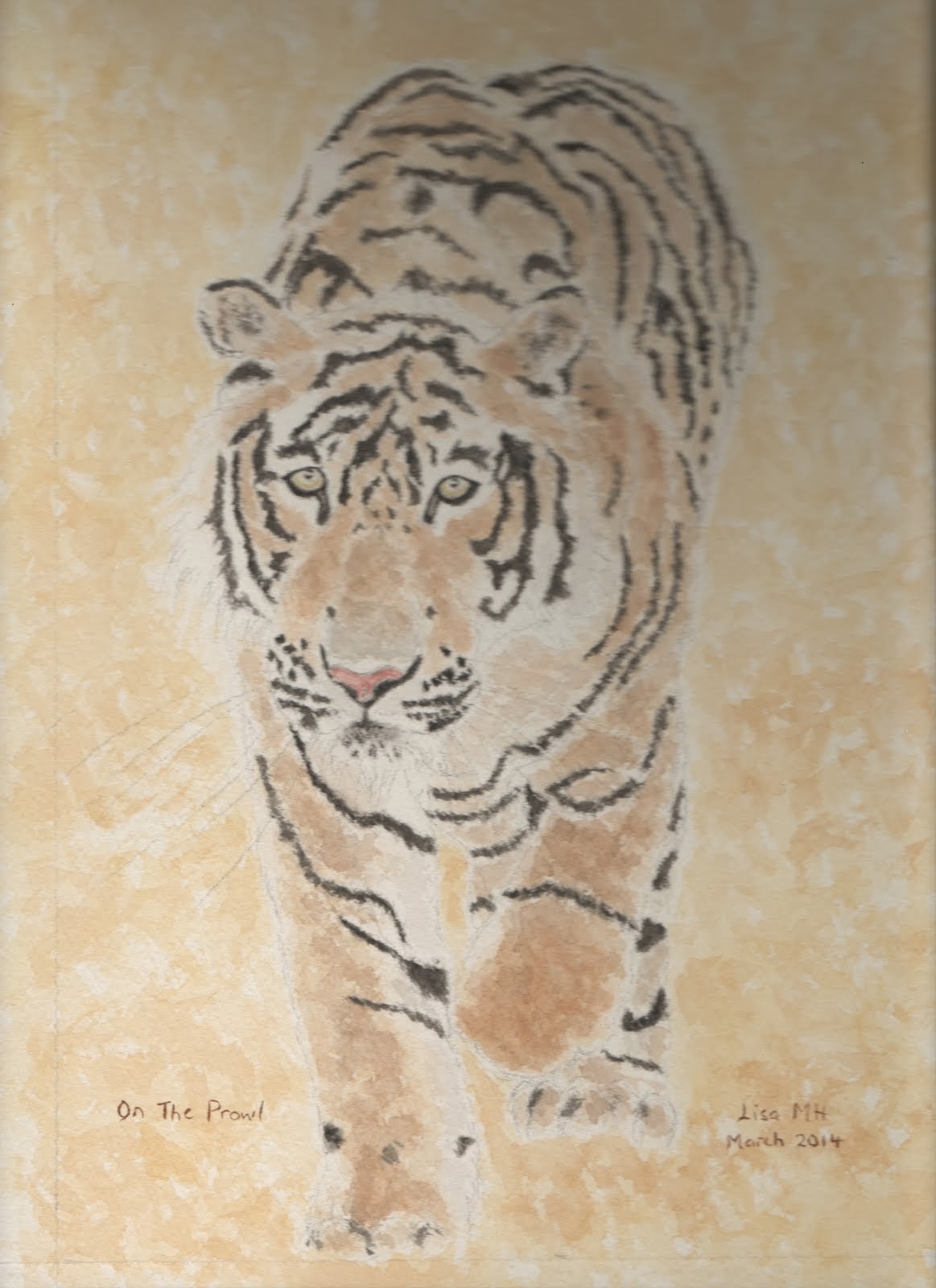
On The Prowl

On The Prowl
Watercolour tiger

Quotes Quota

"What saves a man is to take a step. Then another step."

"There are far, far better things ahead than any we leave behind."

C S Lewis