Feline Focus

Feline Focus
My latest puma, July 2016

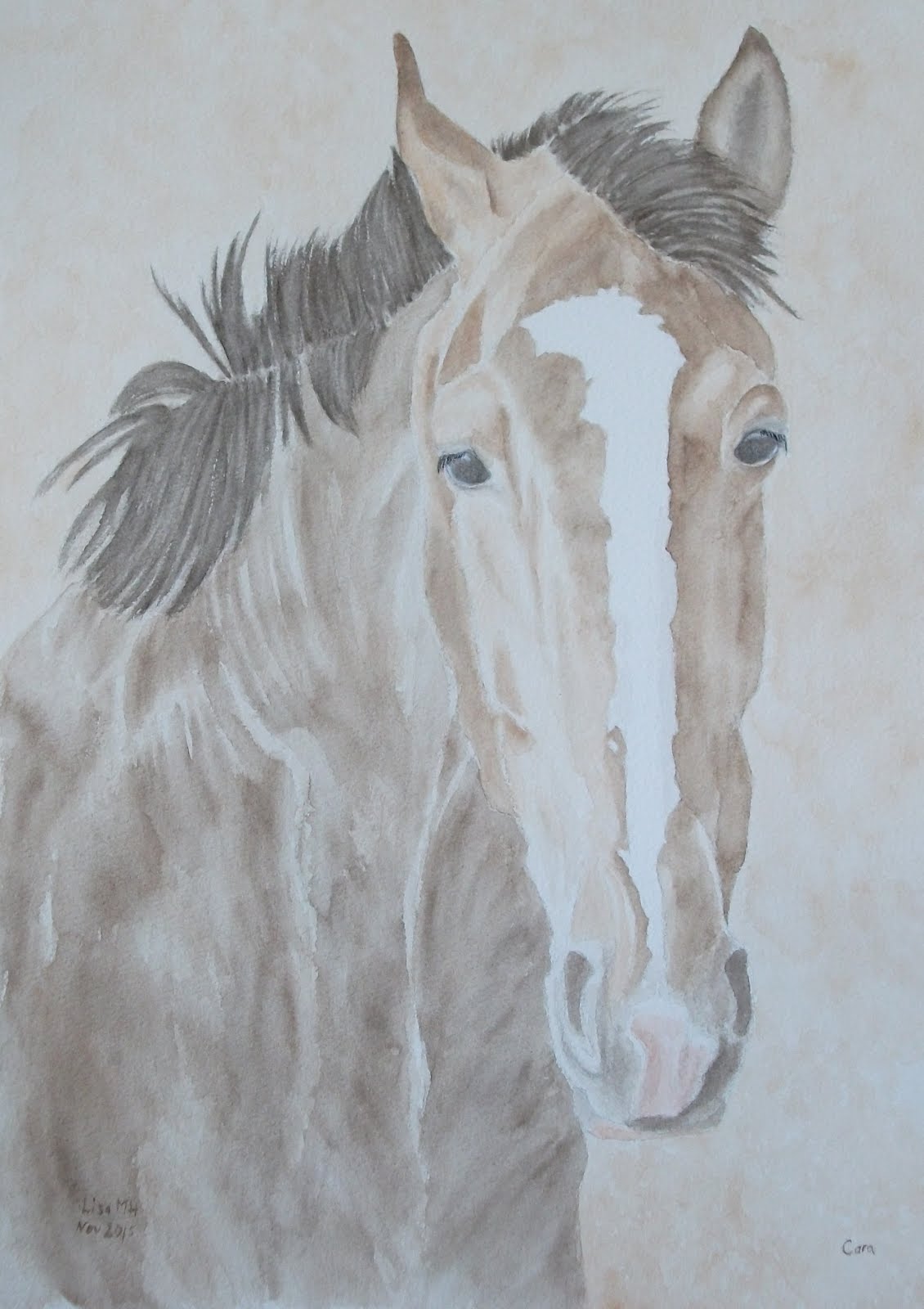
Carra

Carra
Beloved companion to Sarah, Nov 2015

Window To The Soul

Window To The Soul
Watercolour Horse, June 2015

Sleeping Beauties

Sleeping Beauties
Watercolour Lionesses, Nov 2012

QUOTES QUOTA

"Outside of a dog, a book is man's best friend. Inside of a dog it's too dark to read."

"Those are my principles, and if you don't like them... well, I have others."

Groucho Marx


Snow Stalker

Snow Stalker
Another snow leopard - my latest watercolour offering - July 2013
Showing posts with label Copying. Show all posts

30 October 2018

Artistic Interlude

My latest watercolour painting - September 2018


I painted this picture at the end of September - so before my wappy paint-researching-and-buying spree, and after the post in which I announced that perhaps I hated painting, because I certainly don't seem to get a great deal of joy out of it.

It took me five consecutive days to complete, painting for a couple of hours each morning.  I set no goals, other than to simply paint.  I let it take me as long as it wanted to take, and I took my time and slowed the whole process down.  I also kept it simple, using only three colours - burnt umber, raw sienna, and French ultramarine blue.  

Nor did I have the stress of trying to match my colour scheme to that of the original photograph, because the photo was in black and white. And, for once, I didn't confuse matters for myself, and drive myself into delirious indecisive distraction, by referring to all of the accumulated printouts I have of innumerable paint colours and possible mixing combinations.

I have to report that, remarkably, all these conditions together appear to have worked to produce a miracle, and I actually enjoyed this painting experience.  It seems that giving myself the freedom to voice the disquieting thought that I might not like painting after all, allowed me to make a shift from my entrenched position - hopefully not just temporarily.

I also spent less time criticising what I was doing, or the end product. In fact, I actually really like this painting.  It represents a deliberate change in the way I'm trying to paint now - more flow, less rigid control; layering and mixing paint on the paper rather than in the palette; choosing colours I like, rather than trying to replicate those of the subject; trying to paint what I see and feel, rather than the pull of photorealism, and trying to paint what I think I should be seeing.

All of which is quite remarkable for me - the woman for whom change comes at the speed of a tortoise wearing concrete boots.  It's only taken me about seven years of painting to start to break free of the rigid rules I've been confined to trying to follow.  Hopefully it won't take that long for the next change!  

I guess if I stop trying to follow what other people say and do (with my dodgy autistic interpretation skills), which is what has impeded my progress, and trust in my own ability and God's guidance, then I might evolve a bit quicker.  I surely can't get any slower - other than to come to a complete standstill.   


27 October 2018

Iceberg Ahoy!

What I spent five hours doing with my paints instead of painting.  Plus a sample selection of my new paints.

It started with a discount voucher: which happened to be contained within a catalogue.  Two things I have a difficult time resisting.  Add in the fact that it was the biannual art supplies catalogue from Ken Bromley’s, promising a five pound discount IF I spent fifty-five pounds, and that it happened to coincide with my recent desire to extend the range of paints which I own, and I was basically sunk - Titanic, meet iceberg: Lisa, meet paint.

To elucidate further, this means that I have just spent at least two weeks, that’s TWO WHOLE WEEKS (even I cannot quite believe it), trying to decide which new watercolour paints to buy.  

How, in the name of Van Gogh, does a person take so long to make such a decision?  I mean, we’re talking paint here, not whether or not I should have a kidney transplant.  It defies belief; it defies logic; it defies the nature of time, space, and the laws of physics.  But defy all those things I have done, because that’s what I do.  Just don’t ask me how - I’m as baffled as you.

It wasn’t my intention to take so long - but then, as I am slowly learning, nothing I intend ever actually translates into action.  In fact, you can guarantee that the moment anything even vaguely resembling a desire or intention escapes my subconscious and manifests itself either as thought or word, it will sink without trace.  Like the Titanic (I think I see a theme here).

My actual ‘intention’ was to briefly (I obviously have no grasp on the meaning of the word brief) peruse a few art sites with which I’m familiar, in the misguided belief that they would aid me in simplifying and clarifying what to choose.  Already I begin to see the flaw in my argument.  Why would I need someone else to tell me how to choose paint?  It’s not like I’m a complete novice anymore: I know the kind of colours that I like; I know the kind of paintings that I prefer doing.  

But no, all of that knowledge goes out the window because, you see, it’s not about the paint colour - it’s about the pigment.  (Yes, that was just the tip of the iceberg.  No, I couldn’t see the rest of it, hidden beneath the sea of paint waiting to sink me).  And for that I needed an ‘expert’, which required more research: which translates as more time spent on the internet.  Hence two weeks of “research” - more commonly known around here as another obsession.

So, I may not have been doing a lot of painting (nothing new there then), but I now know an awful lot about paint and pigment.  Of course, I can barely recall most of the details, given that I’ve saturated my brain so much that most of it seems to have dribbled out of my ears.  

But I did eventually buy some paints, and then proceeded to avoid actually using them for their intended purpose.  Instead I spent two days ‘testing them out’, and boring myself into a near-catatonic stupor in the process - because, once again, I’d read a load of advice from a bunch of non-autistic artists, all saying the same things about how useful these exercises are to the improvement of one’s art: which translates in my mind as “it’s what ‘proper’ artists do”.  

Oh God, when will I learn that I come from a different ‘planet’, and what works for them doesn’t work for me in quite the same way!  Ah well, it’s done now.  Next I just need a few new brushes...  Oh lawks, I think I see another iceberg looming. *scrambles for lifeboat* 

05 September 2018

A Pain In The Art


Here's my latest painting, which I managed to knock out after a whole lot of the usual lack of self-belief, anxiety-induced executive functioning deficient dithering and inertia (a new thing about which I was recently made aware), which is produced whenever I'm faced with the prospect of needing (even wanting) to put paint to paper.

I may not be improving when it comes to how I feel about my painting, but I have got better at believing in my ability to draw - so, in order to postpone the "dreaded deed", I simply drew a number of things until I felt suitably girded in the loins to take the plunge and get out the painting gear.  And here's the result.

Of course I wasn't happy with it, and gave a running criticism of it while I was doing it - it will be a miracle if the day ever comes when I am, and I don't.  Nor did I particularly enjoy doing it, because I was so fucking uptight and anxious about whether I was getting it "right", and doing it "properly" (those words are the bane of my existence: I shall have them engraved on my gravestone - 'She died right, and properly: indeed, she was a right proper charlie').  

I know "great" artists are often depicted as tortured, hyper self-critical souls, being driven by the unrelenting need to improve and perfect their art, which is often seen as a sign of their greatness, but I didn't want to be one of those kinds of artists who suffered for their art.  I mean, for fuck's sake, I don't know how they ever managed to get anything done if they suffered anything like the bloody insecurities and almost catatonia-inducing fear of making mistakes which I do. 

Perhaps that's the point, though.  Perhaps they don't feel the same.  Perhaps they aren't driven by the same things.  Perhaps at their core they believe that they are great, and they're driven to prove it; and what they fear is being proven to be average.  Me, I have no sense of my own ability, so I constantly seek to measure it against other people - which means I end up trying to copy them, trying to follow directions which I don't fully comprehend (but think I do), and trying to adjust myself to suit another person's modus operandi.  So whenever I pick up a paintbrush it's like there are two people with me at the easel - there's me, and there's whoever is the latest 'guru' artist to whom I've taken a shine, both fighting to stamp their mark on the paper.

I often find myself  wondering whether I'm lying to myself when I say that I love painting.  I mean, you wouldn't think this was the case given the torturous (and tortuous) process I have to go through to motivate myself to do it.  It's like pulling teeth without an anaesthetic.  Perhaps I should just use a bit of reverse psychology, and come out and say, "I FUCKING WELL HATE PAINTING!!!", see if that changes anything.  

Perhaps, though, it's not that I hate painting, but rather that I hate painting the way I think other people paint, or the way I think that other people would tell me I should paint.  After all, I am (annoyingly) also oppositionally defiant, so if I even feel as if I'm being expected to do something (yes, even if it's something I want to do) then I automatically will do the opposite.  Don't ask me why - it's one of the great, unfathomable, frustrating mysteries of my personality, which makes me want to tear my head off and stamp on it.  

So, you want me to paint - I don't want to; you think my paintings are great - I think they're not good enough, probably never will be, and all I can see are the mistakes I made; you think I'm a good artist - I think I'm average, and not as good as... (insert long list of artists' names here), and never will be.  It makes me wonder how I've managed to produce anything at all with a brain like mine.  I should just go and eat worms.

03 August 2018

Photo Fix It

This is just a brief post to say that I finally "fixed" the problem of not being able to get my photos of my artwork uploaded to my blog (as I reported in the post 'Still Alive!' in May), with a little help from my friend, who is the techno-loving polar opposite to my techno-allergenic self.  It turned out to be rather simple in the end - I just had to set up a Google Photos account and post my photos in there in order to be able to upload them on here, because Google won't accept them from iCloud, where they are now saved.  A bit of a faff, but there you go.

So here is some of the artwork I did during my three month painting period at the beginning of the year.  And just to note that I was trying to experiment during this period, attempting to loosen up and play a bit, and break free of the habit of rigidly trying to reproduce what I see in the photos I use as source material: hence the less-than-realistic colour schemes on some of them.  It was intentional and not an error on my part, brought about by a sudden bout of colour blindness!  Suffice it to say, I haven't done any more art since that period came to an end in May/June - as is my way.  As always, in this world of uncertainty, I can be depended upon to be reliably unreliable and consistently inconsistent.


03 November 2014

A Secondhand Life

You may have noticed that I like quoting other people in my blog.  More often than not, I’ll stick a quote, or two, at the top of the page, and away I go.  Sometimes I use it as the starting point, the source of inspiration for what I write: other times it’s like an affirmation of the point I’ve been trying to make.  

Until now I’ve not given much thought to why I do it: I’ve just assumed it’s a good thing, to be able to memorise and then recite things that I’ve read.  I’ve seen it as a sign of intelligence, good memory, and learning.  And I’ve always admired people who can do it; been in awe of those able to spout forth the words of wisdom of others.  Of course, this idea kind of gets blown out of the water when you consider that you can teach a parrot to quote.

Now, I’m not saying that quoting is a bad thing, though only being able to parrot words that you’ve learnt is not really very helpful; being able to use quotes in the right context, understanding what the author meant by them, is a step up.  But, as I’ve recently realised, for me there’s something else going on as well when I use them.  

It’s as if my own words are not enough, like I don’t believe that they carry any weight compared to other peoples’, even if it happens that I am speaking from experience, and they are simply imparting academic knowledge (an example being that of autism, and the precedence I give to the words of those non-autistic ‘professionals’ and ‘experts’ in the field.  If my experience doesn’t match up with what they say, then I discount my experience - or I try to bend it to fit into the autistic-shaped hole that they’ve carved out). 

It wouldn’t be so bad if I confined my use of them to my blog.  But the fact is that I liberally pepper my speech with other peoples’ words, in preference to coming up with something original of my own.  I reference things I’ve read, usually with the words, “It’s like (insert name  here) says in (insert name of book or other source material here) …”, which I’ve now become aware produces the unfortunate result of isolating me from myself, and keeping everything in a state of abstraction - i.e. it all stays in my head, and never touches my heart.  I end up building a life for myself based on my dodgy understanding of someone else’s beliefs (and not just one, but lots of someone else’s).  So it’s yet another bloody form of copying - I just can’t seem to get away from wanting to follow the herd!

And it isn’t as if I can’t think for myself - this whole blog is a testament to the fact that I have plenty of my own opinions and words to share.  I just seem to be filled with such a level of self-doubt that I feel the need to have to refer back to someone else’s interpretation, or experience, rather than trusting my own, and utilising my own words.  I constantly question my own judgement and understanding; and, believing that it’s not quite enough, not quite right, seek to validate it - hence the ubiquitous quotes.

So, in an attempt to divest myself of this habit/trait, I have put aside for the next three months some of the books which I reference frequently, and which are responsible for colouring and shaping a great many of my beliefs and opinions.  Hopefully, not having them to re-read (which reinforces and concretises them in my mind) will lead to me thinking more for myself, and coming up with original ideas, rather than simply dipping into the bottomless pit of my memory.  I think it’s time to give that area of my brain a rest - it’s been shockingly overused, while the rest is in a state of semi-retirement.  

No wonder it takes me so long to get going with writing or art - my brain is fast asleep, and has to be resuscitated first.

01 October 2014

The Declutter Bug

“The ability to simplify means to eliminate the unnecessary so that the necessary may speak.”    Hans Hoffman

“Keep It Simple”

I’ve been decluttering for the past week or so (I’ve kind of lost track of time, as I am wont to do when I get locked onto one of my little ‘projects’).  I say “been”, but the fact is I’m still in the midst of doing it, though it has calmed down to a trickle rather than the flood I had going on last week.  But, even though I had the physical evidence as proof of the extensive clear-out (a massive pile of bags, boxes, and random large items, all carted off to the charity shop), my home doesn’t look that much different.  In fact, if you were to see the state of it, you’d maybe wonder whether I was being delusional, and a tad optimistic: it looks more like I’ve been doing the opposite, what with the chaos that abounds, kind of like the aftermath of a mini tornado. 

So what has it taught me?  Well, apart from the obvious, which is that I hoard things (even though I hate doing it), my approach to the process of clearing out has been an illustration of certain of my ADHD, and autistic, traits running rampant.

Of course, I never meant for it to be - I had every intention of approaching it like a sensible, neurotypical person would, the way I’d read about it on the internet (of course I ‘had to’ go and read about it first, and then keep returning in order to re-motivate myself.  Nothing at all to do with getting distracted by being on the internet… not much).  It’s a wonder I actually managed to get anything decluttered at all.  And it’s why it has taken me so long - ‘cos I don’t really have that much stuff, nor that much space.  I live in a small, one-bedroomed flat.  But there we go.

So I started off in typical fashion - not accepting that, as someone with ADHD and autism, reading about something that is actually very simple was a bad idea, especially given that it was being espoused by a lot of non-autistics/ADHDers; only to find myself, once again, comparing myself to them, and using them as my template.  

And I discovered that, for something so simple, there were a lot of variations, and an enormous amount of blogs/sites out there dedicated to the art of decluttering/living simply/minimalism.  I guess when you’re making a living out of it you’d have to stretch it out, otherwise you’d have nothing to write about on your blog (or in your book/s).  It’s kind of ironic that we apparently need a book, or a blog, full of instructions on how to live simply.  But hey, I’m dumb (and willing enough) to buy the idea.

Of course, when I set out I didn’t really make a decision at all.  I just sort of fell into it, with the desire/need to empty out and get rid of a set of drawers, which I duly did: and then it simply escalated - as these things have a tendency to do with me.  I kept making vague murmurings about needing to slow down, focus on one bit at a time, and not move onto another area until I’d completed that.  But, in true ADHD fashion, I ended up starting in one place, becoming overwhelmed, being distracted by thoughts about what needed doing elsewhere, losing interest in what I was doing, and abandoning it to go start somewhere else, ad infinitum…  

Hence I’m now sitting in a flat in a state of semi-completion, with smaller piles of unsorted clutter in each room - but, still, piles all the same.  I’m beginning to think I might be allergic to order and tidiness, because I never quite get there (‘there’, I think, being a kind of utopian state where everything has a place, and it’s always in its place).  Or I do, but it only lasts for about sixty seconds.  Or I get one bit, or most of it, done, but never quite finish it (I have a problem finishing things in general - and starting them.  But I’m okay with the bit in the middle).  

It’s as if I see the finish line, where the spectre of neatness stretches out in front of me like an endless desert (a bit like an extreme minimalist’s home), and then I seemingly panic and baulk at running through the tape.  I don’t know whether my mind subconsciously worries about what I’m going to do if I haven’t got anything to distract me, and so basically sabotages it all; or whether it’s as simple as me needing to accept that I’m a bit of an untidy person, that it’s a character trait of mine, but as long as I don’t end up hoarding, and let it get overwhelming, it’s okay.  It’s not life-threatening (I’m not going to die from chronic untidiness), and it doesn’t make me a ‘bad’ person.

I’ve been chasing after the illusion of wanting to be a neat person for years, and so far it’s eluded me.  That’s a lot of years.  Perhaps if I stopped chasing it, my own version of order and tidiness might come to me.  After all, there isn’t only one way to be ordered - there are those people who find order in chaos, or enjoy creating order from chaos - perhaps I’m one of those, and I should stop trying to obliterate what might be an essential part of my personality.

When I was on my web-trawl (doing my ‘research’ on decluttering) I saw a photo of Steve Jobs’ office, and it could only be described as looking rather messy and chaotic - and yet he created, and managed, Apple.  Obviously to him his ‘chaos’ was inspiring rather than distracting, and he looked to create order and simplicity in the computers he built, rather than in his environment.  Just think if he’d done what I do, and spent his time worrying about the fact that his room was untidy, and how to go about decluttering it - his Apple tree would still be a sapling, and never have grown enough to bear fruit.  

“To each their own”, as they say.  Now, if I could only stop trying to follow everyone else’s…

10 July 2014

"Aren't I Blessed?"

“You seem so sad, Eeyore.”
“Sad?  Why should I be sad?  It’s my birthday.  The happiest day of the year.”      From ‘Winnie-the-Pooh’, by AA Milne

It’s my birthday today.  I’ve been on this planet, in this corporeal form, exploring this life, for forty-seven years.  Do you know what’s so remarkable, so miraculous about this fact?  When I was almost twenty-one I tried to kill myself.  My life was so bleak, so devoid of any hope, so overwhelmingly joyless, and I so completely unhappy and despairing, that I finally got up the courage to try to end it all.  

I nearly succeeded.  I ended up in the hospital, in A&E, being pumped out, and then spent a few days hooked up to a drip.  The worst of it was that I felt even more hopeless when I came to and realised that I was still alive.  I’d always counted on suicide as a last-ditch option for when life became too unbearable, yet here I was, and it hadn’t worked.  Despair doesn’t begin to do justice to my state of mind at that time.  

Yet here I am, and I can barely describe to you the amazing change that has taken place in my life.  My stay in the hospital catapulted me back onto the psychiatric unit (where I had spent seven weeks, earlier in the year, being detoxed and ‘counselled’ about my drinking), and then into a rehab unit for alcoholics, where I first came into contact with AA and the Twelve Step programme of recovery.

I can’t say that I found the programme, took to it like a duck to water, and my life altered radically at that time.  The truth is I tried reading the Big Book (the basic text book of AA which contains the programme and the instructions on how to do it), and it made very little impact on me at all, other than to confuse me, and cause me to question whether I was, in fact, alcoholic at all, because I couldn’t find an exact match to my drinking ‘career’ or my life and personality.  

I was, of course, reading it literally, and I couldn’t see beyond the words, to the essence of the message.  But at that time I had no clue that I was autistic, and so I took on board the idea that was spouted forth by the ‘average’ non-autistic alcoholics, that I was merely in denial about my drinking, and that I simply didn’t want to admit that I was that bad, that I was alcoholic.

Well, I have to say, for someone in denial I did my damnedest to try to fit the picture of the classic alcoholic, and I stuck it out in the rehab, without a drink, for eighteen months: I was the longest serving resident there.  And on the 21st July this year I will be celebrating my 26th year of continuous sobriety.  People in denial don’t tend to last that long!!  I think, perhaps, the unfortunately misguided people of AA who have a tendency to generalise about alcoholics need to rethink their approach, and consider the fact that there are, among them, many of us who are not wired exactly the same, and who require alternative approaches to cater to our differences.

Interestingly enough, we are covered in the Big Book, which was published in 1939, and is so farsighted it has to have been what we sometimes call ‘a God Job’ - it was divinely/spiritually inspired.  On page 58 of the chapter ‘How It Works’ it says, “There are those, too, who suffer from grave emotional and mental disorders, but many of them do recover if they have the capacity to be honest.”  Even though the language is not what I would use to describe my autism, it is the terminology in current general use.  But then that’s the miracle of the Big Book - despite its age, it remains timeless and relevant in its principles, hence the fact that it has never been altered, other than to add new stories to the personal histories at the back.

So, to return to the narrative of my life, I didn’t leave rehab with a completely altered perspective on life, brimming with joy, hope, and confidence.  I felt much as I’d always felt, a great sense of anxiety and trepidation.  But the one thing I did have was the knowledge that I was alcoholic, and that that meant I couldn’t ever safely drink alcohol.  So I was now sober, afraid of the consequences of drinking if I relapsed (I’d had that fear bashed into my brain), and with no coping skills for life - alcohol had been it.  Oh, and food - which was not as effective as booze, but which now took centre stage.  And not forgetting over-the-counter medication, with which I'd get stoned - not the pleasantest of experiences, but effective in its own way, nonetheless.  

And I was never the kind of person who came into contact with illegal drugs, nor would have had the courage to go and find a dealer - my anxiety around people was so great it precluded any such interactions, unless drunk.  So, since my creative use of medication didn't begin until after I got sober, I was kind of limited: which was, undoubtably, a good thing, as it turns out.  Who knows what type of mess I could have gotten myself into, being such a naive and gullible innocent, and not just with the drugs themselves.  You kind of get the picture?  One addiction/compulsion replaces another.

I lasted six years in this miserable cycle, until I once again reached a place of complete despair and hopelessness, and was ready and planning how to kill myself.  And then a miracle happened - I found an angel!  I reached out to someone I’d known six years previously, who was now in AA, but who actually followed the programme in the Big Book (there are lots of people who don’t, who believe that the programme is in the Fellowship: they are, I believe, sadly misguided).  I admitted that I was not well, and she offered to help me.  She then became my sponsor (my mentor).  She’s also the person who suggested that I might be autistic.  

And, seventeen years later, she remains so, and more - she is my best friend, my spiritual guide in human form, an inspiration in so many ways.  And, even more amazingly, it turns out that she, too, has Asperger’s!  This is the woman I once described here on my blog as being about as autistic as a plastic bag - that’s how perceptive I am!  She was diagnosed at the end of last year, at the age of 66, but it hasn’t made a bit of difference to how she lives her life (other than to answer some questions about certain behaviours, etc that she has) because she’d created a life that suited her, using the AA programme.  She truly is remarkable, and a groundbreaker. 

And so, back to the present.  I have spent my birthday in joyous contemplation of everything that I have in my life - I decided to list 47 things that I appreciate, one for every year of my life, which I duly did on the bus journey into town..  And I have been full of wonder and enthusiasm at the amazing spiritual insights that I’ve been having today, and in the last week or so - I feel like a well that has sprung a leak, the thoughts are just spouting forth all over the place.

I spent the morning shopping in my local market town of Retford, and at the dentist having my teeth de-scaled: not a usual method of celebration, I grant you, but it reminded me of the days when I was drinking, and how I would have to get drunk in order to go to the dentist, so crippling was my anxiety.  Then once I got sober, and had nothing to anaesthetise myself with, nor any way of dealing with the fear of being in such close proximity to another person, I simply stopped going to have my teeth done for the next twenty-odd years.  Fortunately, nothing happened to them in that time, and they stayed remarkably intact and healthy.  And now I can go in there and just get annoyed at the fact that he doesn’t understand my allergy to sugar!

And then I decided that I wanted to share all of this, my birthday, with anyone out there who might be reading this, in the hope that it might give someone hope, or insight, a feeling of connection, or just a bit of a laugh.  There is much to laugh at in this world, and, as I am learning, it only takes an instant to switch a light on, and go from darkness to light - you just have to make sure you’re plugged in and connected to the right Source.  And to think I could have been here twenty years ago if I hadn’t kept sticking my plug in the wrong socket!

And on that profound note, I bid you adieu, and a happy birthday to, and from, me.  ‘Cos, in the words of Eeyore (and Pooh):

“Oh!  Well, many happy returns of the day, Eeyore.”
“And many happy returns to you, Pooh Bear.”
“But it isn’t my birthday.”
“No, it’s mine.”
“But you said ‘Many happy returns’-“
“Well, why not?  You don’t always want to be miserable on my birthday, do you?”
“Oh, I see,” said Pooh.


24 June 2014

Static Cling

“We never do anything well till we cease to think about the manner of doing it.”      William Hazlitt

Have you ever heard the allegory of the centipede which, when asked how it knew which of its hundred feet to use when, found itself unable to move when it started to think about it?  Well, this is me.  Obviously, I don’t mean that I’m a centipede, or that I’ve got a hundred feet.  No: but the minute I think about how to do a thing, you can guarantee I find myself unable to do it.  

Case in point.  I don’t know whether you’ve noticed but, for the first four months of this year, I managed to be extremely consistent and post two blog articles every month.  Amazing, what?!  And I don’t know whether you’ve also noticed that, for the last two months, I haven’t published anything at all?  (Nothing like going from one extreme to the other).  So, what the devil happened?

Well, it wasn’t ‘the devil’, much as I might want to blame it on someone or something else (some supernatural distracting force that body-snatched me, and put a stop to my literary musings).  

To put it simply, ‘I’ happened.  ‘I’ did it.  And the question is, how did I do it?  Well, it wasn’t with a spanner, in the library, with Professor Plum, that’s for sure.

No, it was far easier and simpler than that.  ‘I’ noticed how consistent I’d been, and so ‘I’ started thinking…  

Rather than continuing on with what was working (which meant just going with the flow,  spontaneously writing whenever I had an idea, and not thinking about the logistics of how to do it), I started to worry about how long this would last, and to plot how to ensure the continuation and improvement of this happy state of affairs (meaning posting more blog posts every month, ‘cos I have an obsession with the idea that more is better), I decided to stick my oar in and tinker, once again, attempting to set up a routine for my writing which would maintain and improve my productivity.  Concrete thinking here we come!

I really do have a problem with rigid thinking, and wanting everything to be written in stone, even though you can guarantee that I’ll change it at some point (whether it be sixty seconds, sixty minutes, sixty hours, or sixty days later).  This seems to be one of the areas where the autistic and the ADHD in me clash and/or overlap.  My personality is geared to wanting such tight control of everything, which just exacerbates the rigidity: and vice versa.  

And then there’s what might be the trait of spontaneity (the jury’s still out on whether I have any of this) which longs for freedom, but which possibly transforms and manifests as the flighty impulsivity due to my insistence on attempting to nail it down.  ‘Cos that’s what I do to myself - construct a solid concrete prison, which I call routine, rather than a wooden framework that can easily be altered, dismantled, rebuilt, or added to as necessary.  I don’t so much flow as clunk through life.

So, point in question - writing.  Having unfortunately noticed the longed-for consistency, I determined to set out a routine (set of rules) for my writing that I believed would help me continue with this novel concept which I seemed to have inadvertently stumbled upon.  In short, I got caught up in the minutiae, yet again.  

This meant questioning everything involved in the process of writing - when’s the best time for me to write; how long/how much should I write (eg should I do it in short bursts to accommodate my ADHD, even if I find myself happily focused and wanting to continue beyond the allotted time); how often (daily, every other day, weekly, three times a day, every hour); best place to be (living room, bedroom, kitchen, outdoors); best position (on the sofa, at the desk, at the dining table, on the bed); seated, standing, reclining; on paper or the computer, or rough draft on paper and then computer; one draft or more, rough outline/plan, or leap straight in; what to write - blog article, short story, poem, novel, peace treaty!?  Who knew there was so much to the art of writing, before you even set pen to paper?  Now I see why I often resist doing it!   

And amazingly, as you can see from the evidence, all of my attempts to formalise and formulise my writing has produced miraculous results - I haven’t managed to produce a sodding thing!

Yet I still insist on trying to exert control.  Why is that?  Well, apart from the fact that I just naturally like to be in control, it’s partly because I retain the persistent (but misguided) belief that I can’t be trusted to do anything unless I’m forced into it, using the timeworn method of rule enforcement; and also because, having read copious amounts of info on the subject, I now find myself copying.  Unfortunately, most of the stuff I’ve read (and taken personally and literally) incorporates the concepts I’ve mentioned above, such as disciplining yourself to write daily (another way of saying forcing yourself), etc.  

The fact that most of these people are talking about writing for a living, writing full-length novels, and that they aren’t catering to autistics with ADHD goes completely over the top of my head.  Their motivation is completely different to mine, yet I find myself adopting theirs, which results in writing losing its pleasure for me.  And once it does that, once I start writing from a distorted sense of necessity and fear, then my well of inspiration dries up completely.  Kind of like God saying, “I’m sorry, Lisa, but I don’t want you to write for money or fame or any of those other  materialistic motives: I’d just like you to write for the pure joy of it.”

And it’s not only my writing that I’ve picked apart just lately: I’ve done it with art, too.  Well I would, wouldn’t I?  Once I start doing it with one thing, the trait takes over and spills into everything.  It’s not the individual thing that’s the problem, but me, and there’s no point trying to focus all my attention on fixing the object or situation, in the belief that once I’ve done that then I’ll cease to worry, ‘cos it doesn’t work.  I’ve tried, and failed - numerous times.

So, for example, when I start worrying about one thing, I’ll then find other things to worry about, until I end up in a permanent state of worry, where the focus of my anxiety becomes completely irrelevant.  It’s like setting a time bomb ticking, and letting it run until it culminates in one massive explosion - an autistic meltdown.  Unless, of course, I have the wherewithal to remember to turn the timer off, rather than running around like a loon, trying to manage a live bomb, doing silly things like trying to bury it when it’s still active.

As to art, all of my paintings so far are done by copying from photos.  But a few weeks ago I had a sudden inspiration for something I could do from my imagination.  Of course, it almost scared me to death - I mean, I’ve never been able to draw from my mind (at least, nothing decent: they always resemble the scribblings of a two-year old with hiccoughs, in my opinion), and yet here I was, on the cusp of some great change.  Not only that, the idea I had was abstract: I don’t do abstract.  Obviously God must have been at work, overcoming the confines of my limited imagination, gently nudging me forwards to try something different: especially as I have been saying for a while that I would like to be able to produce my own original work.

But saying it and doing it are two different things.  So what did I do with this spark of an idea?  I obsessed about it, talked about it, did a brief sketch, and then abandoned it in favour of going searching for ways to practice playing and having fun with my art - ‘cos that’s what I decided was what was holding me back, the problem being that I take it all too seriously.  Which is true.  But, basically, my solution was a way of procrastinating about trying something new, and in itself involved trying something new.  How dumb can you get?!  

Which is how come I ended up spending hours trawling the web, looking first at art therapy (I thought it might help me to express myself!?), and then landing on art journalling, which I was convinced was the answer to my prayers (and a way to combine art and writing, so becoming consistent at both at the same time).  I even bought myself a ‘proper’ artist’s sketchbook, with thicker watercolour paper, for the purpose (not thick enough, as it turns out: the pages buckle on contact with the paint.  Sheesh!).  Fortunately it only cost me about £3, and it turns out it’s not the answer to anything, really, other than avoiding doing art.  Which I have successfully managed to do.  As was my unconscious, fear-driven, intention.

You know what I find really strange about all of this, though, and which gives me cause to wonder whether I do, in fact, have the innate ability to be spontaneous (despite my seeming autistic genetic resistance to the whole concept)?  I don’t recall having this problem when I was a child.  I would write stories when I wanted to write, draw pictures when I felt like it, and launch myself into trying things like handstand (and succeeding with persistent practice - something I’m not now well known for) without prior instruction, because that’s what my body wanted to do.  

I didn’t question whether it was possible or not, but simply believed that I could do it, and so just did it.  Whereas now I think I have to have a fucking step-by-step guide to how to do the simplest of things because I’m afraid of getting it ‘wrong’.  Which leads me to wonder whether the problem lies not with a lack of spontaneity, but with having absorbed the idea that there’s a ‘proper’ way to do everything, and that you can’t just decide to do things, willy nilly, without having someone teach you first.

The question is, how did the first people learn how to do everything when there was no-one to teach them?  It’s something my best friend asks me whenever I insist on going off to look for instruction on the internet, clinging like a limpet to the static idea that I need someone to copy, to tell me what to do.  And then I ignore them, or alter the instructions.  So it’s a bit bloody pointless anyway.    


03 April 2014

Fear Is The Key

‘“Ah!” said Rabbit, who never let things come to him, but always went and fetched them.’      From ‘The House At Pooh Corner’, by AA Milne

“Every human thought, and every human action, is based in either love or fear.  There is no other human motivation, and all other ideas are but derivatives of these two.”      From ‘Conversations with God’, by Neale Donald Walsch

I have all the patience of a toddler waiting for Christmas to arrive.  Just like Rabbit, I find it almost impossible to wait for things to come to me, be it inspiration for a painting or a piece of writing, or the answer to some question.

For a long time I believed that this was intrinsically part of my ADHD, but I’m no longer certain that’s true.  I think it just happens that one of my particular personality traits is an excess of impatience (like I seem to have an excess of everything!), and having ADHD exacerbates it.  

It’s as if the ADHD trait of poor impulse control combines with my impatience to produce, or heighten, my distractibility, restlessness, and quick loss of interest.  It’s kind of like they have a symbiotic relationship - the more impatient I become, the more easily distracted, etc.  The same goes with any emotion, whether it be positive or negative, e.g. if I get too happy I find it impossible to calm down, leaving the way open to the familiar ADHD symptoms.

Another characteristic I have, which I believe is part of my autistic hard-wiring, is a bone-deep inability to stop myself from copying, and absorbing.  I say it’s hard-wired because I do not choose to do it.  It happens automatically, without any conscious decision on my part, and more often than not I haven’t got a clue that it’s occurred, until later.  

If I had a choice, I wouldn’t do it - it’s one of the things about having Asperger’s that I actually hate.  It has confused me for a long time because I am so vehemently against the idea of imitating other people: I long to be an individual.  Before I got my diagnosis I wasn’t even aware that it was something I did, probably because I was wandering around with the conscious belief that I didn’t want to be like other people, or follow the crowd.  

But it seems it’s often the case that the conscious thought is merely what you would like to be the truth, and not what the reality is: as in this case.  And everything about me screamed out otherwise - from the way I behaved, how I looked, to what I believed and said.  I was like a walking car-crash, a tangled mess of confusing and conflicting influences, with hardly a sign of the original, intact person left behind.

The fact is that, much as I might be telling myself that I don’t like copying, at the root of me something is going on which I can’t see, which drives me to do so.  And, again, just as with the ADHD, discovering that copying is part of my nature as an Asperger, and trying to attribute it solely to that, has only served to answer half the puzzle.  But I might have finally found the rest.

I copy because I don’t have the patience to wait for an answer, or the faith to believe that one will come in time (God’s time, not mine).  

I copy because it’s easier and quicker than having to deal with the unknown, and the feelings that sprout forth as a result - I can just follow someone else’s path instead.  Unfortunately, this still means that I have to wait for the result, which I also find impossible to deal with, hence my inevitable tendency to chop and change, abandoning one person’s ideas in favour of someone else’s, and never being able to stick to one path and see it through to its natural conclusion.  As I’ve mentioned before, I am the Queen of Tweak.

I copy because when I get distracted, restless, and lose interest (an ADHD attack) it’s the quickest way to fix it, to go on-line seeking new stimulation to try to awaken my dopamine-deficient brain.

Basically, what all of this boils down to is that at the root of me I am motivated by fear.  I fear that if I don’t go and look for the answers then they’ll never come; I fear that I’ll miss out on something; I fear that I might be doing it (whatever ‘it’ is) wrong, and I won’t learn unless I go looking to someone else for the answers; I fear that the feelings will not pass. 

In the words of God (from the book ‘Conversations With God’), “This is what I have called the Sponsoring Thought.  It is either of love or fear.  This is the thought behind the thought behind the thought.  It is the first thought.  It is prime force.  It is the raw energy that drives the engine of human experience.”

So then you put these two things together, the autistic copying/absorbing, along with the fear-driven motivation, and the result is me going searching on the internet for quick answers and inspiration (not to mention it’s distractibility  appeal, which allows me to forget myself and all those pesky feelings that I’m trying to escape).  

But, whilst I might break free for a while, I don’t escape unscathed.  Instead, I return with a confused mess of new ideas and information which will inevitably come back to bite me on the arse at some point in the future, when I’m suddenly reminded of something I read, and decide on a whim to try to integrate it into my life.  Which usually means abandoning something that works in favour of something new that inevitably doesn’t.

Of course, this wouldn’t be such a problem if I weren’t autistic, and if I possessed that miraculous ability to filter information, discarding what isn’t relevant, and adapting what is to suit my needs.  But I don’t.  For some reason, God saw fit to create me without a filter.

It also requires some modicum of self-awareness, to be able to identify what is relevant, and to recognise the commonalities you share with the people about whom you’re reading.  Nope - I don’t have any of that either, and it doesn’t look like it’s coming my way any time soon, much as I’ve kept on striving to acquire it.  Seems this, too, is a hard-wiring issue, and I came out of the factory with the relevant bit missing.

So what’s the answer?  Well, I guess I have to accept that I copy, and always will do, so seeking solutions and an escape on the internet will always be a problem.  It does not hold the answers for me, but merely compounds my difficulties.  My choice is between non-acceptance of my autism/ADHD and it’s limitations (which could be turned over and viewed as blessings), or giving up the fight to prove that I can do what other people do. 

Acceptance means the need to shift from fear into love (and faith) - which means practicing the opposite to what I do at the moment, and start believing that God has the answers, and will provide me with them and everything I need, if I allow Him/Her/It to do so.  Which means trusting that “This too shall pass” (a slogan we have in AA), when I am plagued by feelings - as long as I allow them to do so, by not going off and trying to escape them.  

Filling my head with other peoples’ ideas and opinions does not help me to find myself - it merely helps me to lose touch even more with who I am, as I get buried under a blanket of random useless information.  To act out of love (to trust in God) would mean to honour the fact that I am autistic/ADHD, and so stop doing the stuff which only serves to hurt me.  

Maybe then I could truly embrace the concept of ‘To Thine Own Self Be True’, ‘cos I might finally find the Self to which I could be true. 

07 January 2014

Negative Exposure

“God doesn’t make rubbish, and S/He/It doesn’t make mistakes.”

 Here’s a novel, possibly even radical, idea.  Being autistic/ADHD is an incentive to change, rather than a barrier.

Seriously.  After living with my diagnosis for the last three and a half years, this is the conclusion I have come to.  Yes, there is hope after all!

And when I say change, I don’t mean as in trying to change myself in order to fit into a neurotypical mould, thereby becoming more like them.  I’m talking about the opportunity to embrace who I am, to become all that I am meant to be, to fulfil my god-given potential, as opposed to living up (or down) to the man-made expectations which tell me that I am limited by my ‘condition’.  For this we have the help of the Serenity Prayer,

‘God grant me the serenity,
to accept the things I cannot change,
courage to change the things I can,
and wisdom to know the difference.’

I cannot change the fact that I am an Asperger with ADHD, but I can change the way I manage it in order that it doesn’t impede on my life, but rather enhances it.  It all comes down to how I choose to view it, which in turn determines whether it becomes an asset or a hindrance.  Just like with most things in life, actually, there are always two ways to look at a thing – from a negative or a positive perspective.  It just takes a little practice finding the positive when you’ve become really well-honed at seeing the negative, like I have.  And especially when you’ve absorbed the idea that being negative is part of being autistic, and cannot be changed. 

I have discovered that I am not naturally the gloomy, despondent, negative Eeyore that I long believed I was.  I am actually more of a Tigger – I bounce back so often, and don’t stay discouraged for very long.  To borrow a quote from Rabbit, from The House At Pooh Corner, “Tiggers never go on being Sad.  They get over it with Astonishing Rapidity.”

Yes, I have suffered from an excess of negativity and despondency in my life when I was floundering around, not knowing who I was, or where I was going, and unable to comprehend why I struggled so much with life, and with things with which other people seemed to deal with ease.  

I also now understand that I am such a sponge for other peoples’ emotions and energies, so I would be carrying around with me all that stuff that I had absorbed from the outside world.  And, for the first twenty-one years of my life, I lived with my dad – a seething ball of gloom and negativity, from whom I learnt and absorbed a great deal, most of it not very helpful - though he did teach me how to cook and do housework, for which I am now eternally grateful as it gave me some measure of ability to live independently. 

So my journey has involved working out what is really part of my individual personality; which bits I have assimilated from other people; and how my autism/ADHD fits into the whole picture.

Having been introduced twenty-five years ago to the AA programme of recovery, and the concept of a loving Higher Power, some force greater than man which is directing the universe, I have learnt that there is a reason and a purpose for everything, even when I can’t see what it is.  But that when I am ready and willing to see the truth, and open my mind to it, it will become clear to me.   

I believe that this is what has happened with my autism/ADHD.  My perspective is finally shifting, for the good, and I now believe that God (a term I use as shorthand for referring to that higher force) had a reason for making me autistic/ADHD etc, contrary to what a great deal of the man-made world thinks about it.  But it’s taken a while to get here: and why would it not, when I am surrounded by such negative viewpoints about the whole thing?

From what I have read about them, it seems that a great proportion of the world (including a number of Aspergers and ADHDers themselves) consider them to be a blight, something from which we suffer.  Indeed, there are people out there, scientists and the like, who spend inordinate amounts of time researching these ‘conditions’ with the sole aim of finding a cure.

Do they not realise that such an attitude often contributes to making people like me feel as if there is something ‘wrong’ with me; that I am inherently flawed, and therefore inferior?  This is how I felt three years ago when I was initially diagnosed.  It’s also the main reason I was so resistant to the idea that I might be autistic when it was suggested to me three years prior to my actual diagnosis.  After all, who in their right mind would want to be such a thing, having read that stuff? 

According to them, Aspergers were limited in what they could do and achieve with their lives; they couldn’t change; they suffered depression, loneliness, isolation; they were weirdos who were shunned by society because of their non-conformity; and worst of all (in my eyes), ‘it’ degenerated with age – progressing like some rampant disease, until they were inevitably, and totally, incapable of any level of independence, thereby resulting in the need for the intervention of care workers, or being shunted off to live in care homes.  What a fucking depressing prognosis!  With these terrifying prospects in store, is it any wonder I refused to consider the possibility for so long?   

So is it any wonder we often suffer from depression, and other negative consequences, when there is such a level of non-acceptance (not to mention ignorance about the subject) in the world for us, an attitude which we then absorb into ourselves (being, as we are, so sensitive to such stuff), which in turn leads to a lack of self-acceptance? 

I believe that people often make the mistake of attributing all depression, and negativity, to the fact that we are autistic – almost as if it is an innate part of the ‘condition’ itself.  We all have different personalities, just like non-autistics: and just like some non-autistics are depressive in nature, so too does the same truth apply to us.  We are human beings who happen to be autistic, NOT autistics who happen to be human beings.  It’s taken me a long time to recognise this, and stop thinking of myself almost as some kind of automaton.

To pinch another quote, this time from one of the stories in the Big Book of AA (page 449 in the third edition), 

“And acceptance is the answer to all my problems today.  When I am disturbed, it is because I find some person, place, thing, or situation – some fact of my life – unacceptable to me, and I can find no serenity until I accept that person, place, thing, or situation as being exactly the way it is supposed to be at this moment.  Nothing, absolutely nothing, happens in God’s world by mistake... unless I accept life completely on life’s terms, I cannot be happy.  I need to concentrate not so much on what needs to be changed in the world as on what needs to be changed in me and my attitudes.”

I cannot change other peoples’ attitudes or perspectives about Asperger’s/ADHD: there will continue to be those who consider it a blight, an illness, a flaw in our genetic make-up.  However, I can change my own attitude, and stop reading that stuff, and stop believing what other people say about me.

It’s now three and a half years since I was officially diagnosed, and I have to say that, though the journey has been extremely difficult at times, I am no longer in the same place that I was back then.  I have come to know the truth (or more of it) about my Asperger’s/ADHD, and you know what?  All those people who believe that we’re somehow disadvantaged, sick, not right, in need of their pity and their interference (sorry, I mean help), have got it wrong.  They’ve missed the point. 

The fundamental point is that being autistic with ADHD makes me individual, gives me a unique perspective on life, and offers me an alternative set of circumstances to navigate – which, in turn, provides me with a divergent opportunity for growth and change. 

As my best friend often reminds me, “There are many ways up the mountain.”  

And, as Aslan says to Aravis in The Horse And His Boy, “Child,” said the Voice, “I am telling you your story, not hers.  I tell no one any story but his own.”  

And my story is my own, and no-one out there can tell me what it is.

Snow Leopard

Snow Leopard
An experiment in watercolour and gouache

Quotes Quota

"Do you believe in Magic?" asked Colin.

"That I do, lad," she answered. "I never knowed it by that name, but what does th' name matter? I warrant they call it a different name i' France an' a different one i' Germany. Th' same thing as set th' seeds swellin' an' th' sun shinin' made thee well lad an' it's th' Good Thing. It isn't like us poor fools as think it matters if us is called out of our names. Th' Big Good Thing doesn't stop to worrit, bless thee. It goes on makin' worlds by th' million - worlds like us. Never thee stop believin' in th' Big Good Thing an' knowin' th' world's full of it - an call it what tha' likes. Eh! lad, lad - what's names to th' Joy Maker."

From 'The Secret Garden', by Frances Hodgson Burnett

Love

Love
Copied from photograph of the same name by Roberto Dutesco

Quotes Quota

"There is no way to happiness - happiness is the way."
The Dalai Lama

"If you don't stand for something you will fall for anything."

Malcolm X

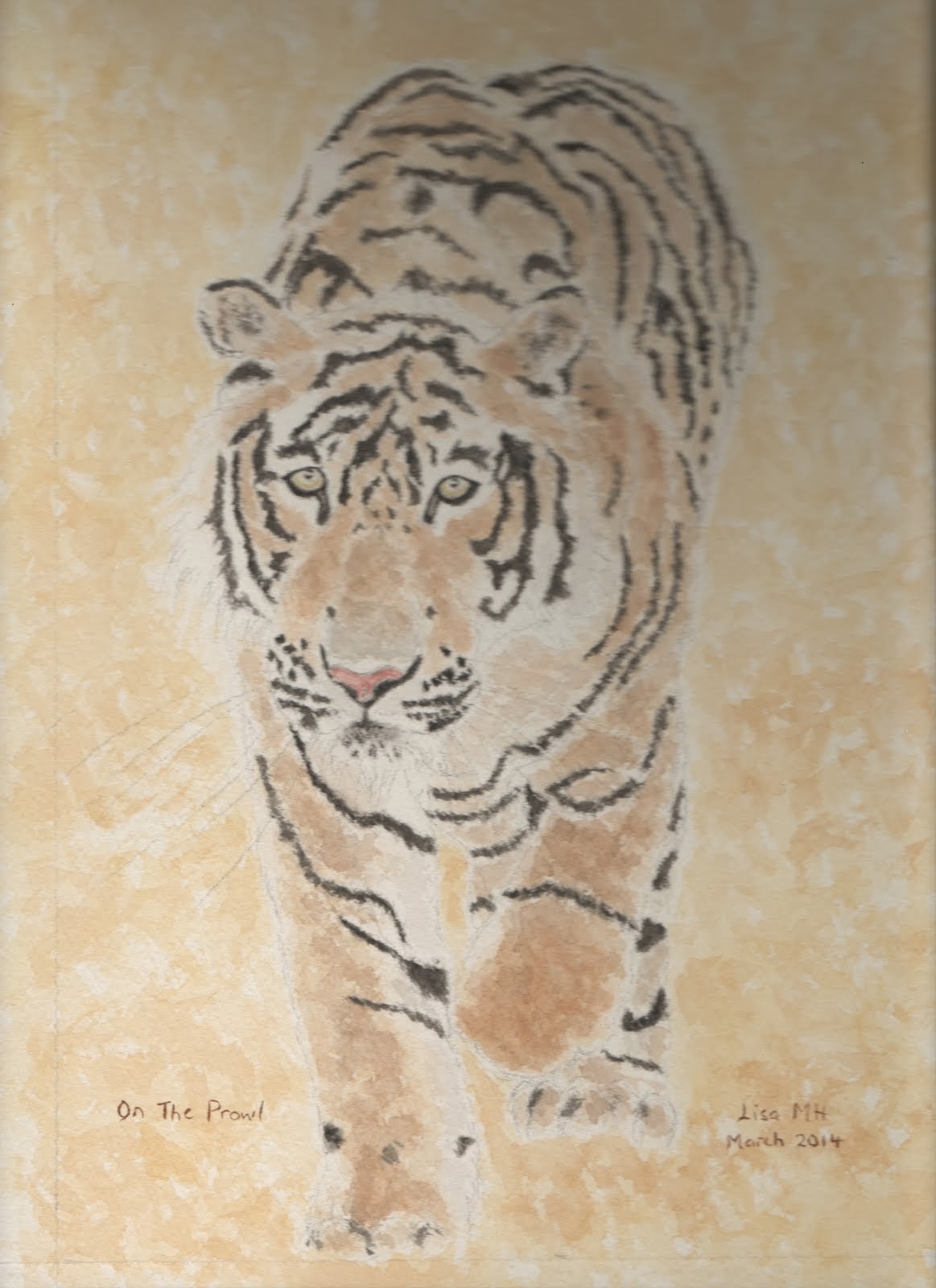
On The Prowl

On The Prowl
Watercolour tiger

Quotes Quota

"What saves a man is to take a step. Then another step."

"There are far, far better things ahead than any we leave behind."

C S Lewis