


I guess I’m just going to have to find a technology-free zone, and go live there. So, it’s back to the 1970’s then.
25 February 2015
Weapons Of Mass Distraction
When I gave away my television fifteen years ago, I never imagined that I would one day have to retread the same ground, with what has inadvertently turned into its successor - the computer.
At that time I had an old, slow, desktop version, which I barely used; and, hard to believe given my present cavalier use of the internet, back then I was loathe to surf the web (barely sticking a toe in), and wouldn’t shop, bank, or do anything on-line which involved money, not trusting at all the safety of such procedures. I was still choosing to use dial-up when broadband became widespread, and had to be coaxed, cajoled, and coddled into upgrading, which happened only when I bought my first laptop five years ago, and despite my attempts to remain a dial-up dinosaur.
So attached was I to my t.v. that I can still vividly remember the circumstances of its final relinquishment, including the last thing I watched (the Williams sisters contesting the women’s Wimbledon final). And what is also indelibly imprinted in my mind is the aftermath of our separation.
As the decision to get rid of it had taken months, maybe even a year or more, to reach (involving countless failed attempts to control my compulsive viewing, and deny or minimise the suggestion of it causing me a problem), it shouldn’t be a surprise to find that I felt quite bereft, and lost - though this all occurred ten years before I found out about my autism, and that, as such, attachment to things is an innate part of my being.
Therefore, not only was I mourning the loss of the activity itself and what it did for me (helped me to lose myself, and avoid dealing with reality - much like alcohol, and food, for which it had inadvertently become a replacement after I stopped drinking, and compulsively overeating), but also the object.
So, here I was, only three years later, discarding what had been one of my most prized possessions. The question was what was I going to do with myself now that my primary source of entertainment, distraction, and information had gone? How would I live without my weekly dose of Buffy? How would I know what was going on in the world (having also developed a compulsion for reading the teletext pages)? How would I fill my time, not to mention the physical space which the set had occupied?
I did what any self-respecting distractible, executive functioning-challenged person would do - I started using my much-maligned, and under-used, computer to read up on what was happening in the final series of Buffy, and to check on other things of major importance (like the sports news). Additionally, I found something else to replace it - the local library, and its endless bounty of books in which to lose myself. Oh dear.
All of which turned out to be merely the entree, an appetiser to the compulsion which would once more escalate with the purchase of my first laptop (with integrated dvd drive, and large screen - specifically chosen in order to recreate, as much as possible, the experience of viewing films on television; plus my introduction to the world of broadband, and instant internet access); my first Apple product (an iPod Touch, on which I initially discovered the world of on-line book reading via the iBooks app); and the failed experiment of the Kindle (now permanently removed from my life, with no hope of a reprieve. *Sigh*).
As to the gaping physical hole which the television had left in my home, that I did not immediately fill (bloody typical). For the remainder of that day, and continuing on for a week or maybe more, everything remained exactly as it was, except for the rather large space where the shrine to moving pictures had dwelled. And there I would sit, gazing into the void, imagining my t.v. and the noise it used to make when I switched the on/off button - a solidly reassuring “thtunk” sort of sound. I can still hear it now…
Fast forward to the present, and imagine my dismay to find myself once more embroiled in obessive/compulsive technological torture; and to discover that, ever since I purchased my first laptop and launched myself onto the internet, I have been unwittingly attempting to replace the television, using it primarily as a source of entertainment, and a place in which to lose myself.
Despite choosing to buy a laptop with an integrated dvd drive, and the biggest screen I could find specifically for the purpose of film-watching, it never once occurred to me what I was doing. Until the most recent manifestation of my compulsion: a hard-drive filled with over two hundred films, for my instant-access viewing pleasure - like locking me in a sweet shop, and expecting me not to eat everything. Dumb.
And a fortnight is all it took for what was meant to be a thoughtful gesture on the part of my friend, to be revealed to be yet another error in judgement a la the Kindle. Actually, it took two days for my behaviour to become apparent (sitting and watching as many films in a row as I could fit into the day, whilst everything else got forgotten), but we were trying to give me the benefit of the doubt, holding onto the hope that the novelty would wear off, and I would settle down and learn to manage it. That’s what I kept hoping would happen with the television. It never did.
Therefore, after only two weeks, I had to relinquish the hard-drive full of films to my friend, for her to wipe it clean and send it back to me… empty: to be used for something productive. Bugger. *Deep sigh*. I even checked it in the forlorn hope that perhaps she had left a few on there, by error or design, but she hadn’t. The only evidence remaining was the title ‘Lisa’s Films’, sitting there on the desktop, taunting me with the memory of what had been.
So, having diced with yet another weapon of distraction, I can only surmise that if God had intended for me to spend large amounts of time on the computer, I would have been born a technogeek - which I positively am not. On the other hand, my autistic friend is. She can spend hours engrossed in playing, and sorting out difficulties, with technology. She loves it when it develops a problem, so she can spend time sorting it out. Yet she doesn’t get distracted, like I do. On the contrary, she’s in her element, happy as a pig in a truffle field. Her interactions with technology are creative: hence, she doesn’t lose herself on here, but rather connects with the part of herself which is technologically-minded.
Not so with me. When I try to play I get lost, bored, and end up trundling off to the internet to try to reignite my synapses - which is my idea of playing on the computer, and is kind of the techno version of mall shopping: there’s a whole lot of consumption goes on, but nothing creative happening. How, in the name of Santa’s socks, does one play with a computer? It simply doesn’t compute for me.
I’ve also realised that it’s not just that technology makes me anxious, but it just bores the arse off me. I’ve tried to get excited about it; to do what my friend has suggested and play with it; to basically copy her; but it just isn’t happening. The only thing that excites me is surfing the internet (which is not good for me), and typing up my writing (which I happen to be good at, fortunately love doing, and which isn’t difficult to do on here).
Where I connect with my creative self is in writing, art, and, in a different form, yoga (where I create calm, harmony, and a sense of order, in my body, mind, and spirit - well, that’s the theory anyway, yoga being about the union of the whole. Can’t say I’ve quite mastered the art yet… but I have fun trying). And even with these things I’ve found it difficult to embrace the concept of playing, but I understand how it can be done.
However, to my friend the idea of yoga is as tedious as watching paint dry - the moment I even mention the subject, a fixed smile settles on her face (almost as if rigour mortis has set in), and her eyes glaze over. Exactly as I do with computers. See, it’s all a matter of personality: we were not all meant to like, or be good at, the same things.
So I’m having to adjust my perception of the purpose of my computer, and alter the way I use it accordingly. Which, for me, means it’s primarily a tool for my writing, a means of connecting with other people (which I do very little of), a source of shopping, and a way to play my Kundalini yoga dvds (Maya Fiennes - ‘Detox and De-stress’, and the series ‘A Journey Through The Chakras’).
I’ve realised that it’s a bit like maths - I can do enough basic maths to serve my daily needs, and that’s enough. I’ve never found a need for logarithms and the like, nor a burning desire to try to master them. Yet with my computer I persist in the belief that I’m meant to understand and be able to utilise every app and function, of which I have no need, rather than accept that, like maths, I have enough basic skills for my purpose, and that my use of it is meant to be limited: if it wasn’t I’d have no time to write, paint, or do yoga. As it is I often have no time to do those things anyway because I’ve got caught up on the web. Never was there a more aptly-named instrument.

12 January 2015
Christmas Crackers
So, that was Christmas, eh? And I hardly felt a thing.
Did you feel it - the Christmas spirit? And, if so, could you enlighten me as to what it feels like, ‘cos I haven’t got a clue. (I realise that I am lagging behind somewhat with my dissection of the festive season, but there we go: it’s time I got used to the idea that I’m hopeless when it comes to trying to work to a deadline, so I shouldn’t even bother trying - it’s not like my life depends upon it. I’m just never fully prepared for any event: so christmas, and new year, have been and gone, and I’m only just digesting them.)
There’s a Christmas song called I Believe In Father Christmas, which contains the line, “The Christmas we get we deserve.” I used to think it was like an adult variation of the idea that Santa Claus wouldn’t bring you anything if you’d been bad, which I considered was rather gloomy and depressing: but I’ve reassessed the idea, and come up with a different understanding. And it’s really quite simple (which explains why it’s taken me so long to grasp it).
I think that it’s basically saying that however you have been throughout the year, is how you’ll be at Christmas: the person you are the rest of the year is not going to have a sudden personality transplant and become someone completely different just because it’s Christmas. All that Christmas does is magnify already existing conditions and emotions, what with all that extra stress piled on top.
So if, for example, you are envious, competitive, depressive, angry, short-tempered, lonely, greedy, materialistic, etc then that’s what Christmas will likely bring out - an increase in such characteristics, exacerbated by the influence of those sections of the media which target and promote such a negative traits as greed, materialism, and consumerism. Alternatively, if you happen to be a generally happy, content, sharing, joyful person then Christmas will just be another opportunity for more of the same.
As for me specifically, it has highlighted things like the fact that I still have a tendency to make my happiness, and other emotions, dependent on things outside myself (be they people, places, or things), which contributes to the desire to want to control said outside circumstance in the misguided belief that that will change how I feel; that I am extremely gullible, naive, literal, and childlike (believing, hoping, that there is such a thing as the magic of christmas); having high, unrealistic expectations, which always lead to disappointment; taking things way too seriously (apparently, there are people out there who don’t tie themselves in such knots about the whole thing, despite the apparent frenzy that appears to go on at this time of year); comparing myself, and what I’ve got, to other people (or what I imagine they have, which is not necessarily their reality), and trying to copy them; and, of course, simply finding myself caught up in, and being distracted by, yet one more obsession. All of which I do quite happily the rest of the year. So what’s so different about Christmas?
As much as I hate to say it (and I really do hate to say it), there is no such thing as ‘the magic of Christmas’, contrary to what the media (or my mind) says. But they’re very good at selling it (both the media and my mind), especially to someone like me, whose gullibility and naivety is just begging to be taken advantage of. And every year I’m left feeling disappointed - though, I have to say, I have noticed that the disappointment is lessening with each passing year, as I try to accept that Christmas isn’t any different to any other time).
You know the irony of this is the fact that my whole lifestyle now is completely in conflict with everything that I’ve learnt that Christmas is all about - stuffing oneself on turkey dinners, mince pies, Christmas puddings, and other rich foods; alcohol; parties, and family gatherings; presents; cards; Christmas television; carol services; and the birth of Jesus.
I’m a single, non-religious yogi, vegan, alcoholic/bulimic/compulsive overeater with a sugar sensitivity, anxiety suffering autistic with ADHD. Which, just to clarify, means:-
I live on my own, and have little contact with the family I do still have - so no family get-togethers, and Christmas dinners, and no gift-buying;
I don’t socialise ‘cos it’s too stressful, it makes me anxious, and I don’t enjoy it - I’m happiest when I’m by myself, which is good ‘cos I’m by myself most of the time;
I have a faith in a Higher Power, which I choose to call God, but I don’t believe in Christianity, or any other religion, so I can’t honestly claim to celebrate Christmas for its religious symbolism - especially as I know that Jesus wasn’t born on the 25th of December: a person chose that date, so it really holds no magical significance for that reason: so there go the church services, and carol singing;
I don’t eat meat (so there goes the turkey!);
I don’t drink alcohol (so there goes the mulled wine, hot toddies, and getting sozzled at parties);
I don’t eat anything with sugar, or sugar substitutes (so there goes dessert - all the chocolate, pies, cakes, etc), or any of my other many binge foods which were once staples in my diet;
I don’t send cards, because I no longer wish to do what everyone else is doing, being coerced into doing the dutiful, but meaningless, thing of remembering people at this time of year, whilst forgetting about them for the remainder. Plus, think of all those trees;
I don’t own a television (so there goes my Christmas viewing);
And I do yoga, and follow a Twelve Step recovery programme, the principles behind which are in complete opposition to the general excess and mayhem which Christmas seems to have become.
So it’s really rather daft for me to be comparing my circumstances to other peoples’, and attempting to copy the way I see (or imagine I see) them celebrating Christmas, or the way I used to do, when I no longer have the necessary requirements. But I’m nothing if not tenacious - I do hold onto things way past their sell-by date. And I think my ideas about Christmas are far beyond outdated.
Of course, I also have a very poor short-term memory, so no doubt next year I’ll be experiencing exactly the same ‘problems’ as this year (and every year prior to that). But Ho Ho Hopefully it won’t last as long. At least now I don’t start dreaming of a White Christmas at the beginning of September.
03 November 2014
A Secondhand Life
You may have noticed that I like quoting other people in my blog. More often than not, I’ll stick a quote, or two, at the top of the page, and away I go. Sometimes I use it as the starting point, the source of inspiration for what I write: other times it’s like an affirmation of the point I’ve been trying to make.
Until now I’ve not given much thought to why I do it: I’ve just assumed it’s a good thing, to be able to memorise and then recite things that I’ve read. I’ve seen it as a sign of intelligence, good memory, and learning. And I’ve always admired people who can do it; been in awe of those able to spout forth the words of wisdom of others. Of course, this idea kind of gets blown out of the water when you consider that you can teach a parrot to quote.
Now, I’m not saying that quoting is a bad thing, though only being able to parrot words that you’ve learnt is not really very helpful; being able to use quotes in the right context, understanding what the author meant by them, is a step up. But, as I’ve recently realised, for me there’s something else going on as well when I use them.
It’s as if my own words are not enough, like I don’t believe that they carry any weight compared to other peoples’, even if it happens that I am speaking from experience, and they are simply imparting academic knowledge (an example being that of autism, and the precedence I give to the words of those non-autistic ‘professionals’ and ‘experts’ in the field. If my experience doesn’t match up with what they say, then I discount my experience - or I try to bend it to fit into the autistic-shaped hole that they’ve carved out).
It wouldn’t be so bad if I confined my use of them to my blog. But the fact is that I liberally pepper my speech with other peoples’ words, in preference to coming up with something original of my own. I reference things I’ve read, usually with the words, “It’s like (insert name here) says in (insert name of book or other source material here) …”, which I’ve now become aware produces the unfortunate result of isolating me from myself, and keeping everything in a state of abstraction - i.e. it all stays in my head, and never touches my heart. I end up building a life for myself based on my dodgy understanding of someone else’s beliefs (and not just one, but lots of someone else’s). So it’s yet another bloody form of copying - I just can’t seem to get away from wanting to follow the herd!
And it isn’t as if I can’t think for myself - this whole blog is a testament to the fact that I have plenty of my own opinions and words to share. I just seem to be filled with such a level of self-doubt that I feel the need to have to refer back to someone else’s interpretation, or experience, rather than trusting my own, and utilising my own words. I constantly question my own judgement and understanding; and, believing that it’s not quite enough, not quite right, seek to validate it - hence the ubiquitous quotes.
No wonder it takes me so long to get going with writing or art - my brain is fast asleep, and has to be resuscitated first.
So, in an attempt to divest myself of this habit/trait, I have put aside for the next three months some of the books which I reference frequently, and which are responsible for colouring and shaping a great many of my beliefs and opinions. Hopefully, not having them to re-read (which reinforces and concretises them in my mind) will lead to me thinking more for myself, and coming up with original ideas, rather than simply dipping into the bottomless pit of my memory. I think it’s time to give that area of my brain a rest - it’s been shockingly overused, while the rest is in a state of semi-retirement.
No wonder it takes me so long to get going with writing or art - my brain is fast asleep, and has to be resuscitated first.
Subscribe to:
Posts (Atom)
Snow Leopard

An experiment in watercolour and gouache
Love

Copied from photograph of the same name by Roberto Dutesco
On The Prowl
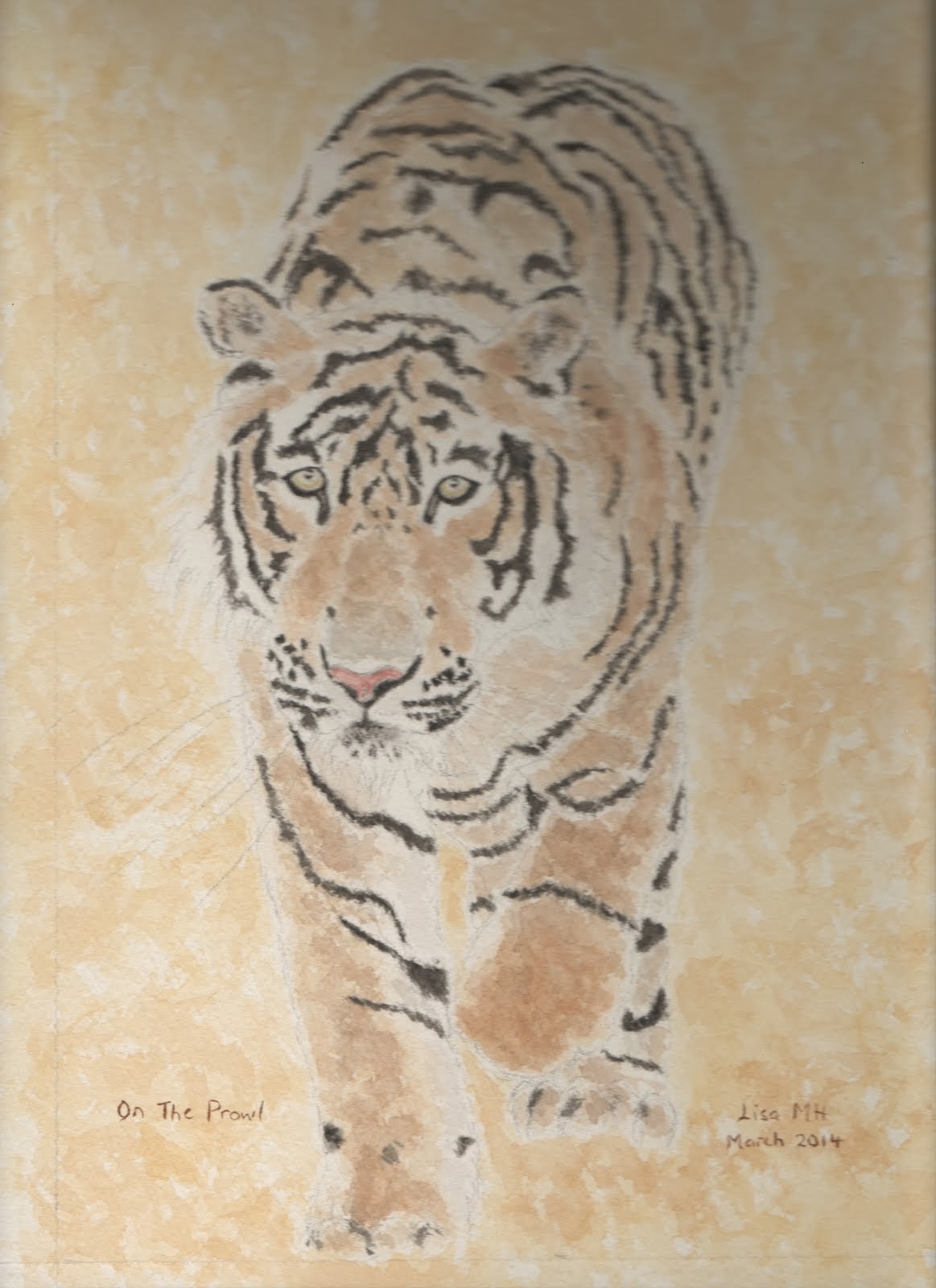
Watercolour tiger


